
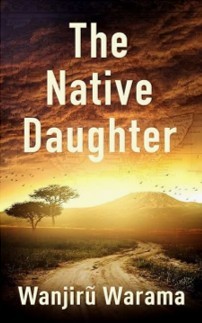
The Native Daughter: A Memoir of Movement and Change by Wanjirũ Warama

 Reviewed by Pennell Paugh
February 28, 2026 (La Mesa) -- Wanjiru Warama, a resident of La Mesa, CA has released a new memoir, The Native Daughter. The author tells stories of her family, the community, and her growing years in Kenya during the mid-1900s.
Warama shares her and her siblings’ memories and insights with compassion and depth. Family dynamics as well as social forces all come into play in her book. Her stories also shed light on the struggles of Kenyan farmworkers and rural populations under the British colonial rule, especially during the Mau Mau rebellion where her family was moved three times to camps.
Native Daughter is compelling and astonishingly positive given the abject poverty under which the author and her family members suffered.
Below is a scene from the book. In it, six years old Warama takes a bus to town with her father. They are taking sick infant brother, Wawerũ, to the hospital. Her mother is already in the hospital for a snake bite and her father cannot afford to take time off from work. As a result, little Warama will be required to share the same hospital child safety bed with her infant brother for over a week while he is treated.
Wawerũ snugged on my back in a ngoi, its strap across my tender head. In Mother’s absence, Ndurumo, my fifteen-year-old brother, took her place. He threw a piece of cloth over the baby and helped me tie it around my chest to reinforce the baby carrier. I then joined my father, who was waiting in the courtyard.
He and I left the village early that morning to catch the only bus between Solai and Nakuru Town. The dew on the footpath through the savanna wet my feet, but only for a short distance before we branched onto a dirt and stunted-grass tractor trail, an occasional fixture on colonial farms in Kenya.
On the two miles to the bus stop, my heart warmed in anticipation of my first bus ride. I had never ridden in a motor vehicle before. At the roadside, I kept an eye down the road, eager to enjoy the ride for all eighteen miles to town.
Will the trip last the entire day? I asked myself. That would be such a thrill …
From the bus station, Baba [her father] held my hand—the only time he did so, unless I count the first time, which I’ll ignore for now, the afternoon he whipped me with a twig when I was four. All I can say and wallow in is that I felt safe and anchored when he held my hand this second and final time. He helped me cross two streets as we weaved back the way our bus had come. He dropped it when we reached the curb by the roundabout.
I stayed close behind him as we walked on the shoulder of the Nairobi/Nakuru road. We covered about half a mile before turning onto another jacaranda-lined street that led us to Nakuru General Hospital …
I am unsure how long we waited, seated on benches along the corridor with others—mainly barefoot rural women hugging their sick children—before a nurse came to get us. She led us to a room where we found a white doctor. She offered the two chairs by the doctor’s desk and handed me the baby. She then stood aside, between the doctor and us.
He asked questions in his language, a language I had never heard before, which I soon learned was English. The doctor’s look fascinated me more than his language. I watched him, maybe even gawked, wishing I could touch and feel his fragile-looking, skinless hand. Would he feel pain? I wondered. Years later, when I finally touched a white person’s hand, I learned how mistaken I had been. It turned out to be skin like any other.
It was my second time seeing a white person; my first sighting was at my mother’s job three years prior, but that was from at least fifty feet away.
Wanjirũ Warama is a Kenyan-American biographical and historical nonfiction author born who was raised in Kenya during a time of profound cultural and political change. She later immigrated to California, where she continued her education and built a life shaped by resilience, curiosity, and the power of story.
Born and raised on a British colonial farm, Wanjiru is the daughter of peasant laborers who had no formal education. Her writing is deeply shaped by this unique upbringing, her travels across all seven continents, and her journey as an immigrant in the United States. Warama’s eight books preserve the lived experiences of ordinary people whose histories rarely reach the page.
Having grown up in a home without books, Wanjiru understands the transformative power of education. Her own high school struggles—marked by poverty and resilience—are the subject of her upcoming memoir. She believes education is the most powerful tool for breaking free from the dehumanizing grip of poverty.
An active philanthropist and advocate for literacy, Wanjiru is a lifetime member of the Friends of the San Diego Public Library, the Rotary Club, and the San Diego Writers and Editors Guild.