
Will the AI bubble burst? How AI generators are remaking reality

 Screenshot from WION on AI
East County News Service
March 16, 2026 (San Diego) — According to Businessman and Attorney Andrew Yang, “The jobpocalypse is here.”
He expressed fears that Artificial Intelligence predicts a staggering 99 percent unemployment in the next five years.
As of early 2026, AI’s impact on aggregate unemployment remains subtle, with roughly 90 percent of executives reporting little significant change in headcount due to AI since late 2022. However, significant disruption is emerging in specific and high exposure entry-level white collar roles, potentially causing a 0.1 percent to 0.5 percent rise in unemployment.
While overall employment remains stable, young workers in AI-exposed fields have seen higher unemployment rates. While many experts see only moderate disruption, some projections suggest that AI could displace 6 to 7 percent of the workforce, with potential for 10 to 20 percent unemployment in specific sectors if AI adoption accelerates quickly.
Impact on the work force
The United States unemployment rate was 4.4 percent in February 2026, with approximately 7.6 million people unemployed. With AI taking away jobs from workers and everyday Americans, this may get more complicated.
AI has and will disrupt the job market, inciting fears that AI-powered automation will displace workers. According to a World Economic Forum report, nearly half of the surveyed organizations expect AI to create new jobs, with almost a quarter see it as a cause of job losses.
AI is transforming the job market by automating routine tasks, augmenting human productivity and creating new roles, as well as projections that suggest a net gain of 69 million jobs worldwide, despite displacing others. Those job fields that are high-risk, like office support and coding, while high-demand areas include AI development and data analysis.
According to previous data in 2023 by IBM, approximately 40 perceent of the work force in the U.S. may need to reskill within the next three years to adapt to AI-centered changes. The World Economic Forum projects 85 million jobs may be affected or replaced by 2024, while simultaneously creating new and specialized roles. The “labor gap” is expected to widen between workers with AI skills and those without, requiring an increased attention to training and adaptation.
The companies that announced large headcount reductions since AI has revised talent strategies or faced public criticism. For example, the Swedish fintech “Klarna,” which offers the “buy now, pay later” e-commerce loans, reduced its human workforce by 40 percent between December 2022 and December 2024 when it invested in AI.
It is worth noting that the company used a hiring freeze and natural attrition, not layoffs to achieve this cut.
However, the company’s CEO told Bloomberg in 2025 that Klarna was reinvesting in human support, explaining that it prioritized lower costs which created “lower quality.” Subsequently, a spokesperson told HBR that Klarna hired about 20 people to deal with customer service cases that AI cannot handle, stating that using AI "changes the profile of the human agents you need in the customer support role.”
Additionally, the language-learning Duolingo company announced that AI would ultimately replace too many human contractors, and has faced considerable criticism on social media.
The state of AI in the U.S. economy
Artificial Intelligence is rapidly warping and controlling the modern world and its economy. More than 37 percent of businesses and organizations around the world use AI in their activities, and this percentage will keep increasing.
The hundreds of billions of dollar companies that are investing into AI now account for a 40 percent share of the US GDP growth this year. Some analysts believe that this estimate does not even in fact fully measure the AI spend, so the real share may be even higher.
AI companies have accounted for 80 percent of the gains in the U.S. stock market since 2025, and that is helping fund and drive the US growth as the AI driven stock market draws money from all around the world.
It is very much ingrained in our daily lives, where it has its hands in the decision makings of human beings like loan lending, vehicle driving and the performances of small business.
Since the wealthiest 10 percent of the U.S. population owns roughly 89 percent of U.S. stocks, they enjoy the largest wealth effect when the stock market fluctuates. There is little wonder that the largest data shows that the American consumer economy is mainly upon the spending of the wealthiest.
The top 10 percent of earners account for half of consumer spending— the highest share on record since the data began. Ever since the anxiety and excitement surrounding AI began, the US economy might have stalled.
No nation has seen an immigration boom-bust cycle near the scale of the one currently ruling America: net immigration nearly quadrupled after 2020 to peak at over 3 million in 2023. However, the backlash to immigration spearheaded by President Trump has sent that figure to a fall.
This year, only 400,000 net new arrivals are expected, and this could be the trend for the coming years.
AI boom on products
The AI boom has driven up prices across multiple sectors by creating intense demand for resources, with PC and smartphone costs expected to rise by 10 to 20 percent due to memory chip shortages lasting into 2027. Data centers are also fueling higher electricity costs (about a 6.9 percent increase back in 2025), while software subscriptions are increasing by 5 to 10 percent as firms incorporate AI features. Companies like Microsoft 365, Notion, and Salesforce are raising prices on services by 5-10 percent as well after incorporating AI “Copilot” or assistant features.
AI is driving prices through three channels: rising hardware costs, aggressive software bundling, and utility-driven inflation. Although AI promises long-term efficiency, the current “boom” is causing massive spikes in the cost of consumer electronics, software subscriptions and basic electricity.
The demand for AI data centers has now triggered a global shortage of memory and storage components, as chipmakers prioritize high-end AI chips over consumer-grade parts:
● Smartphones and PCs: the cost to build a smartphone or laptop is expected to rise by 6.9 percent to 15 percent in 2026, and for manufacturers like Nothing, device prices could jump up to 30 percent.
● Memory (RAM): Prices for random-access memory have more than doubled since late 2025, with some vendors reporting quotes of 500 percent higher than previous months.
● Storage (SSD/HDD): Data centers are consuming so much storage that hard drive production capacity for 2026 is almost sold out, keeping prices higher for the near future.
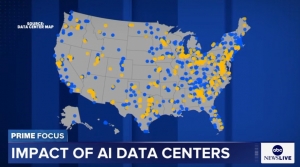 Screenshot: Graph of U.S. Data centers from ABC News Analysis
Data centers are projected to consume about 12 percent of the total US electricity by 2028. This AI demand drives electricity prices up to 6.9 percent in 2025, more than double the rate of inflation. In areas with heavy data center activity, wholesale prices have surged by as much as 267 percent over five years.
The rapid expansion of AI companies in hubs like San Francisco has driven rents up by 6 percent, which is double the rate of New York City. Additionally, Goldman Sachs warns that higher energy costs for businesses will “trickle down” into the prices of food and clothing. It is worth noting that companies are increasingly using AI to implement dynamic pricing, where the cost of a prediction is based on individual data.
AI can analyze browsing history and location to estimate a user’s willingness to pay,” sometimes resulting in price differences of more than 100 percent for the same item based on ZIP codes. One example is Instacart, which recently faced scrutiny for AU pricing tests that inflated grocery bills by up to 23 percent while airlines like Delta are testing AI to set real-time ticket prices.
Views about AI
According to a 2024 summer survey by Pew Research, roughly half of U.S. adults say that AI will have a very (24 percent) or somewhat negative (26 percent) impact on the news that people get in the US over the next twenty years. Just 10% say it will have a very (2%) or somewhat (8%) positive effect.
Republicans and GOP-leading independents tend to have much less trust in national news organizations than Democrats and Democratic learners do. Despite this, the groups are mostly aligned in their views of the impact of AI on news and journalism.
About one-in-five Republicans (21 percent) and Democrats (18 percent) state that AI would do better at writing a news story than journalists, with Republicans being slightly more likely than Democrats (54 percent vs. 49 percent) to say that AI will have a negative effect on the news people get over the next two decades.
Both parties are very concerned about people getting inaccurate information from AI, with 67 percent of Republicans and 68 percent of Democrats (sharing those views).
Americans with at least some college education are more pessimistic than high school graduates about AI’s impact on the news and journalism. 56 percent of Americans with at least a college degree and 54 percent of those with some college education say that AI will have a negative impact on the news, compared with 44 percent of those with less education.
Those adults with at least some education are also more likely than those with less formal education to say that AI would do worse than journalists at writing a news story today.
The Trump Administration's role
During his second term, President Trump and his administration's social media accounts have increasingly used AI-generated imagery and videos for political messaging, a practice that experts and critics characterize as a source of misinformation.
The Trump administration has used AI to mock and discredit political rivals, such as its deepfake of Hakeem Jeffries, and a White House X account mocking Senator Elizabeth Warren, and its most recent and racist video of Barack and Michelle Obama.
Other posts have shown realistic but edited images of protestors, such as civil rights attorney Nekima Levy Armstrong, in order to portray them in a negative light.
AI has been used to visualize policy outcomes, such as a video depicting a prosperous “Trump Gaza” with luxury resorts and gilded buildings. Trump has used AI to spread misinformation, such as when he shared images falsely suggesting that Taylor Swift had endorsed him.
President Trump has also been accused of using the “liar’s dividend,” where the existence of deepfakes allows him to dismiss authentic and unflattering footage as “probably AI.” He has explicitly stated that if something “really bad” happens, he will “just blame AI” to avoid accountability.
The administration's AI Action Plan put emphasis on private-sector dominance and has sought to remove references to “misinformation,” “diversity, equity and inclusion,” as well as “climate change” from federal AI safety frameworks. White House officials defend the use of these images as “satire” or “banger memes,” arguing that they are effective tools for connecting with their base.
Experts from institutions like Rutgers University warn that regular dissemination of deepfakes from official government accounts erodes public perception of truth, and makes it difficult to discern fact from fiction.