
 Printer-friendly version

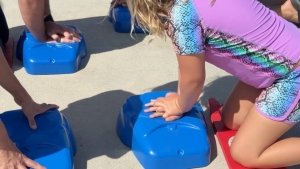 Photo courtesy County of San Diego
East County News Service
Jan. 25, 2026 (San Diego County) -- A local movement to turn bystanders into lifesavers is in the home stretch.
Since its launch in January 2024, the Revive & Survive San Diego initiative has successfully trained more than 750,000 people in hands-only Cardiopulmonary Resuscitation, moving San Diego County closer to its goal of 1 million trained residents.
A joint effort between the County of San Diego and UC San Diego's Herbert Wertheim School of Public Health and Human Longevity Science and County Emergency Medical Services, the program has been designed to create a "coalition of lifesavers" across the county.
The scale of the problem is eye-opening. According to the American Heart Association, cardiac arrest claims more lives globally than colorectal, breast and prostate cancers, influenza, pneumonia, auto collisions, HIV, firearms and house fires combined.
Despite these numbers, the solution is fairly simple. Unlike traditional methods that required mouth-to-mouth resuscitation, hands-only CPR focuses exclusively on high-quality chest compressions. It involves pushing fast in the center of the chest at a rate of 100 to 120 beats per minute. This action keeps blood flowing when an individual's heart stops beating, providing the best chance of survival.
In the world of emergency medicine, every second is a commodity, says Kristi L. Koenig, M.D., medical director of County Emergency Medical Services.
"Cardiac arrest can happen to anyone, anywhere, anytime," Koenig said. "With a 7 to 10 percent decrease in survival for every minute CPR is not performed, people can make the difference between life and death by taking a few minutes to learn this simple skill."
Dr. Koenig called the 750,000-person milestone a "remarkable accomplishment" that highlights the power of community action. The data supports the urgency: administering CPR immediately can double a person’s chances of survival.
The initiative has helped improve local statistics.
In 2021, only 8.2 percent of people who experienced out-of-hospital cardiac arrests in the county were revived and survived. While bystander CPR was initiated in nearly half of those cases (48 percent), officials believe that increasing the number of people trained in chest compressions will save even more lives.
To reach this point, the program has hosted more than 14,000 training sessions. As the initiative pushes toward its 1-million-person target, residents are encouraged to seek out no-cost training opportunities to join the effort.
For more information, click here.



Recent comments