
 Printer-friendly version

By Miriam Raftery
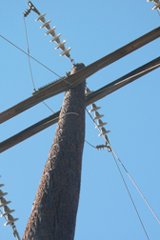 |
| Clark contends that the installation shown here, with two down guy wires connected by a single bolt, is dangerous. SDG&E denies that contention. |
February 24, 2009 (San Diego’s East County) — Ed Clark,
an electrical protection engineer-turned-whistleblower, contends that inappropriate
power line installations by SDG&E/Sempra Energy have caused multiple wildfires
in San Diego County – and that the utility’s refusal to replace or correct
the installations leaves our region at risk for more fires.
SDG&E disputes Clark’s claims and insists that its installations are legal
and safe. (See our story: Investigator claims fault utility line installations
caused 2003 Cedar and Paradise Fires as well as fires in 2007; SDG&E disputes
claim). Now
East County Magazine has spoken with two additional electrical engineering
experts—and both confirm Clark’s contention that such installations are dangerous.
We first spoke with Dave Brinson of Denver Magnetic, a former electrical protection
engineer and expert in the field of electrical transformers and related apparatus.
“I’m aware of what Ed is doing and investigating, and I agree with him,” said
Brinson, whose company has hired Clark as an investigator of electrical fires
in the past. He recalled a case involving a transformer fire. “He
was onsite maybe 20 minutes and figure out what the problem was.” Clark,
who won numerous awards when working at the engineering department for Southern
California Edison, has a reputation as one of the premier experts in his field,
with both theoretical understanding and hands-on experience, as a utility-trained
tester and technician with an engineering degree, Brinson noted.
After Edison sold the Huntington Beach Power Plant, Brinson recalled, “We
had Enron saying there was a shortage of power in California so everyone was
scrambling to generate whatever they could. The owner wanted to flip
the switch on the other half of a power plant that had been mothballed, but
you just can’t do that,” he said, adding that it was Clark who insisted that
the entire power plant be retrofitted first to assure safety. “He’s really
the only expert that I would go to,” Brinson said.
Brinson confirmed that a fault in a 69kv line causes ground current to flow
back to the source “always”, adding that he has photos of a man who attempted
to steal copper wire from a substation. “It blew him into pieces,” he
said.
What if a subtransmission 69kv line is built on wood poles in a high-wind
area with two down guy wires without insulators, attached by a single bolt? Would
that create a path for electrical ground current to flow up from one anchor,
through the bolt and down the other anchor? “Absolutely,” said Brinson,
who also confirmed that arcing can occur when anchor connections are not bolted
and connections at ground level are making and breaking contact as a result
of high winds.
“That installation is incorrect,” Brinson said. “I asked colleagues
the same thing and they said no, you can’t do that without an insulator. It’s
common sense.”
Asked his reaction to SDG&E’s refusal to fix the installations, Brinson
replied, “I would say that they are negligent.”
David Mossman, controlling partner at Global Power Systems in Santa Barbara,
has designed substations and been involved in transmission line installations
and electrical distribution for utility companies in Canada. He,
too, confirmed that the installations in question could cause arcing and ignite
fires.
Asked specifically if the installations in question could cause fires, he
replied, “Absolutely, yes they can. I come from Canada and that method
of installation is not allowed in Canada. You can’t install two guy wires on
a single pole without insulators.”
He added, “The other thing to remember is if one of the wires carrying the
high voltage across the pole falls down and hits the guy wire, it would go
to ground and start a tremendous electrical fire. Whereas if you have
insulators, that would not happen. You just have to put the insulators
on.”
SDG&E would not need to replace poles and fixing the problem on a regional
basis would not be prohibitively costly, in his view.
“The cost of the insulator would be thirty bucks, plus the time—an hour or
two per insulator—to get someone in there to do that.”
Told of the statements made by Mossman and Brinson, SDG&E spokesperson
Stephanie Donovan replied, “Our position has not changed due to the fact that
you have two other people who think this scenario is possible….Do you think
we haven’t had all kinds of people scrutinizing our installations regularly,
especially since the fires?” Of the experts interviewed by ECM, she observed,
“One of them doesn’t even practice electrical engineering in California and
is trying to compare them to Canada.”
She affirmed, “We believe that we continue to build and operate our station
in compliance with strict state and federal standards, and the California Public
Utility Commission, FERC and Cal Fire have alls aid there is nothing to this…There
is nothing that needs to be fixed. This is a standard that applies throughout
California, both to Edison and to PGE as well as SDG&E.” An SDG&E
Powerpoint presentation refuting Clark’s allegations
also states that “the grounding system we employ is widely used by other utilities,
including Southern California Edison.”
Clark sent a
rebuttal to ECM calling that statement “a bold-faced
lie” and said Southern California Edison’s Transmission Construction Methods
book has a specific construction standard, T0201, which states that two down
guy wires must be attached by a distance of 12 inches apart on the pole (see
exhibit #5 at www.theelectricalexpert.com)
Donovan said Clark was “misinterpreting” requirements of GO 95, a state standard,
and that “he in at least one instance has suggested design changes [adding
insulators] that are specifically prohibited by the standard.” Donovan
wrote in an e-mail to ECM. She further stated that Clark “has no factual
or field measurement to support his claim that sufficient current is induced
to cause arcing.”
SDG&E argues that the common bolt connection between guy wires is part
of a federal standard to protect safety of electrical workers and system. “It’s
vital for safety that all hardware at the pole is at the same voltage potential
(to reduce the chance of electrical shock. The common bolt ensures the attachment
hardware for both down guys are at the same voltage potential.”
Clark called the latter statement “an ignorant comment by SDG&E” and maintained
that since both down guy wires are at the same potential and tied to their
own guy anchor,, “there is no need to “ensure.”
He contends he has been denied opportunities to prevent further evidence to
the CPUC, Cal Fire and SDG&E. “The irresponsible actions by the California
PUC, Cal Fire and SDG&E should prompt a federal investigation where all
involved including the lawyers are questioned under oath with the full understanding
f the consequences if they lie to a federal prosecutor,” he concluded. “All
SDG&E employees, executives, Cal Fire employees and CPUC employees who
have acted with intentional negligence on a atter that involves the safety
of the general public, should be penalized to the maximum extent of the law.”



Recent comments