
 Printer-friendly version

 By Karen Pearlman
March 19, 2026 (El Cajon) — A deepening rift between local autonomy and state mandate is in the spotlight in El Cajon after Mayor Bill Wells sent a letter to the attorney general earlier this week.
The El Cajon City Council, already divided since a 2025 resolution giving support to cooperating with federal immigration authorities to remove undocumented immigrants convicted of major crimes, continues to stay fractured.
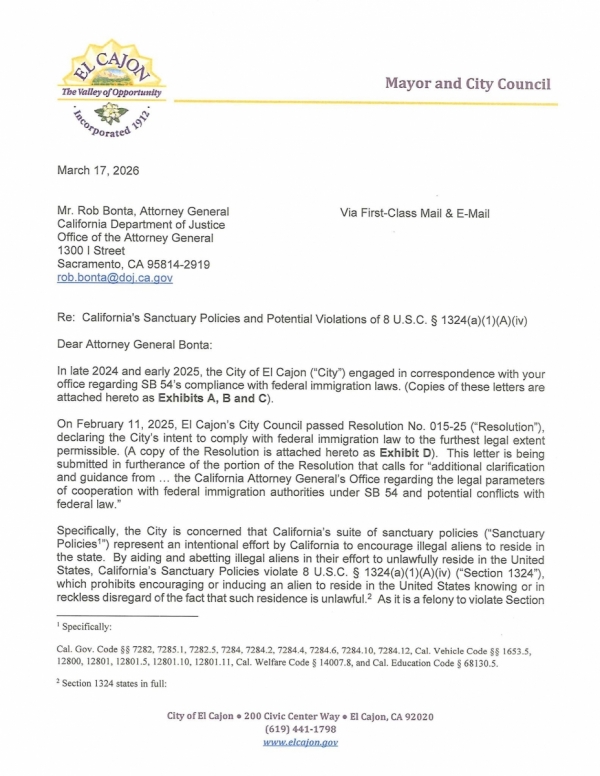
A letter dated March 17, 2026 from Wells to California Attorney General Rob Bonta marks the city’s latest challenge to Senate Bill 54 from 2017, the California Values Act, which the Mayor alleges has created a legal "Catch-22" that endangers vulnerable children.
The letter said that the city is "concerned that California's suite of sanctuary policies represent an intentional effort by California to encourage illegal aliens to reside in the state (unlawfully)."
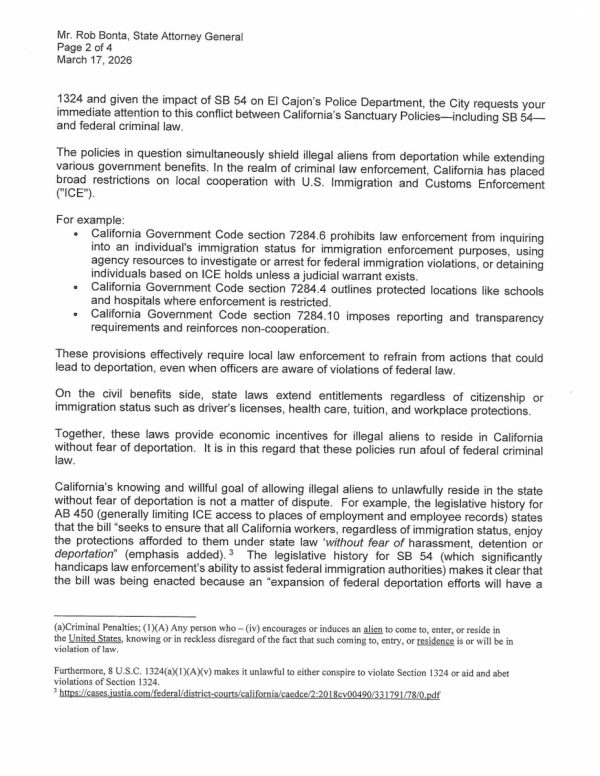
The letter said that California laws "provide economic incentives for illegal aliens to reside in California without fear of deportation. It is in this regard that these policies run afoul of federal criminal law."
It also notes that the policies are impacting the El Cajon Police Department.
Wells, City Councilmembers Steve Goble and Phil Ortiz were in favor of the letter's content and message, with councilmembers Gary Kendrick and Michelle Metschel opposed.
The standoff centers on the city's intent to cooperate with federal immigration authorities to the "maximum extent permissible," a move that flies in the face of California’s strict sanctuary protocols.
At the heart of the current dispute is a year-long effort by Goble to coordinate with federal agencies regarding unaccompanied minors.
Goble recounted a face-to-face meeting with local leaders of U.S. Immigration and Customs Enforcement and U.S. Department of Homeland Security investigations shortly after President Donald Trump administration's took office.
"They said, 'Hey, we have a list of 52 unaccompanied minors who might be living in El Cajon ZIP codes,'" Goble said.
According to Goble, federal agents asked for local assistance in ensuring the children were safe. "I said OK, that we'd like to do wellness checks on these kids in El Cajon..."
When Goble reached out to Bonta, the response from the state AG's office told him, 'No. No you can't.'"
The refusal, Goble said, was based on the premise that local police visiting these addresses would effectively confirm the locations of undocumented minors to federal databases -- a violation of state law.
Wells characterized the state’s stance as a moral failure.
"(When) the Department of Justice in California wrote a letter back and said, 'No you can't' do wellness checks, it was like, 'You're so sold out for illegal immigrants that you're not going to let children be rescued from sexual slavery.' That's a bridge too far for me."
Understanding the SB 54 'wall'
Signed into law in 2017, SB 54 (The California Values Act) was designed to build trust between immigrant communities and local police by ensuring that interacting with local law enforcement wouldn't lead to deportation.
Specifically, the law prohibits local agencies from providing ICE with personal information, such as home addresses or work locations, unless the individual has been convicted of specific serious or violent felonies; prevents local jails from holding individuals beyond their release date for ICE pickup without a federal judicial warrant; and forbids the use of local funds or personnel to investigate, detain or arrest people for immigration enforcement purposes.
For Wells, these restrictions also create an impossible choice for El Cajon Police officers.
"Our police officers are put in a really bad situation," Wells said. "If they aid and abet people that they know are here illegally, they're breaking federal law. But if they cooperate with the feds, then they're breaking state law... Frankly, police officers are not allowed to break laws."
When asked about the possibility of future legal action on the matter, Wells said he could not comment on any possible pending litigation.
Council members and community members weigh in
While Wells and Goble emphasize the importance of the removal of dangerous individuals from the city of El Cajon -- noting that ICE removed five or six immigrants with prior criminal histories including kidnapping and assault from (incorporated) El Cajon last year -- not all on the council agree with the approach the city is currently taking.
Kendrick said he wasn't able to speak at length about the issue at this time but said that "I opposed the original resolution strongly and I also oppose the letter."
Metschel, who has remained a vocal critic of the city's non-sanctuary city push, also distanced herself from the mayor’s letter.
"I voted against the resolution last year as I thought it wasn't necessary and political theater," Metschel said. "We do not have an immigration problem in El Cajon. I did not want my name on this letter and have said that I want no part in it."
Goble maintains that the issue is one of basic human welfare.
"There are going to be more... 350,000 are here, and they've found 20,000... and I would fight for every last one of them to make sure they're OK," he said.
While advocating for a solution for law-abiding residents, he remains adamant that SB 54 is an obstacle to protecting the vulnerable. "I don't care about the guy who is behaving."
Goble compared the law-abiding immigrant to those who came decades ago, a la the "Ellis Island model," using history to frame a potential "middle path" for non-criminal residents.
From 1892 to 1954, Ellis Island served as the primary gateway for 12 million people, functioning on a model of rapid vetting and immediate integration for those who proved they could work and support themselves.
Local activist Estela De Los Rios said that "the core issue is one of safety and protection."
De Los Rios sasid that law enforcement's duty is to serve and protect, not to act as federal immigration officers.
"Allowing them to do so creates significant risks -- financial liabilities for the state/locality; health and welfare issues for families who are deterred from accessing necessary services like grocery stores, clinics and hospitals out of fear; and violation of privacy through the sharing of personal information with law enforcement."
De Los Rios said that she supports the arrest of all criminals, but added that "their immigration status should not determine whether they face justice. No public official should be above the law, nor should they usurp the responsibilities of the federal government."
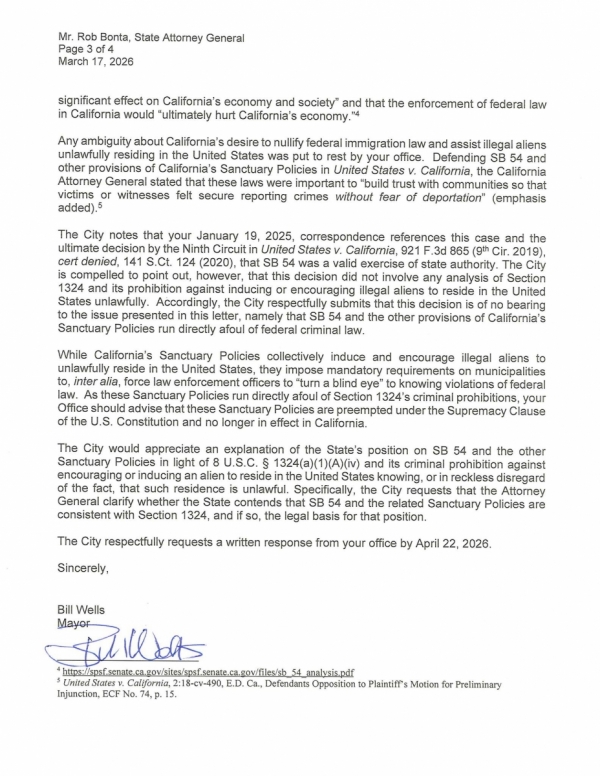
In the letter to Bonta, Wells gives the Attorney General's office until April 22 to reply.
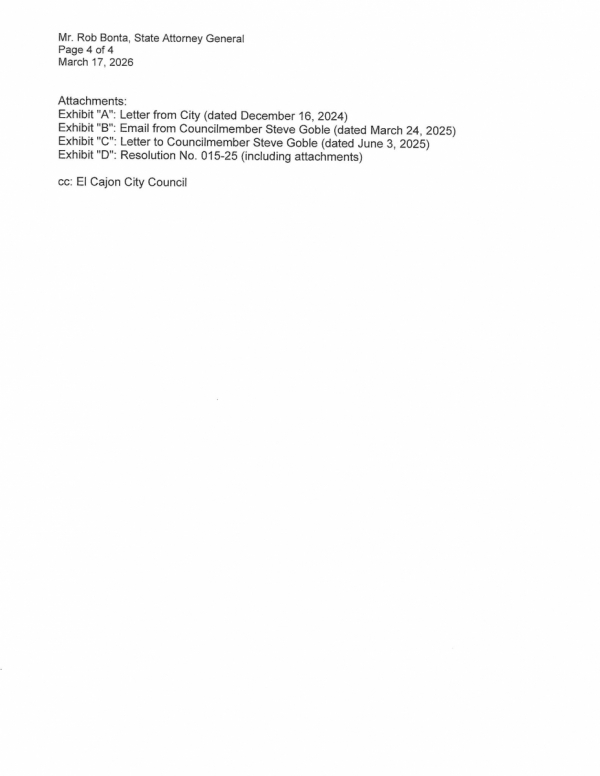
The four-page letter to Bonta is shown in photos below:









Comments
wake up El Cajon