
 Printer-friendly version

 By Miriam Raftery
Photos: Tazheem Nizam, CAIR San Diego executive director, and Shawn VanDiver, president of AfghanEvac
December 17, 2025 (San Diego) – Local community leaders who have worked to help Afghan refugees are speaking out over new restrictions imposed on Afghan immigrants following the shooting of two National Guard member in Washington D.C. on November 26 by Rahmanullah Lakanal, an Afghan asylum seeker. A female National Guard member died of her injuries.
Lakanal, who previously worked for the CIA-backed Kandahar Strike Force attacking suspected Taliban members and aiding American troops, reportedly was suffering mental health issues before the Washington D.C. shooting, for which he was arrested.
While denouncing the violence and calling for accountability or the shooter, the local leaders also call on Americans not to demonize all Afghans for the actions of one man.
President Donald Trump recently ordered the suspension of all immigration case reviews people from 19 nations, including Afghans with pending asylum applications. Earlier ,in July, Trump also shut down the Coordinator for Afghan Relocation Efforts (CARE) which has assisted Afghan relocation efforts since the fall of Kabul.
Those restrictions hit home hard here in San Diego County, home to one of the largest communities of Afghan residents in the U.S., including many in San Diego’s East County. That includes refugees, Special Immigration Vista holders, green card holders, and family members of Afghans who helped the U.S. military during the two-decade long 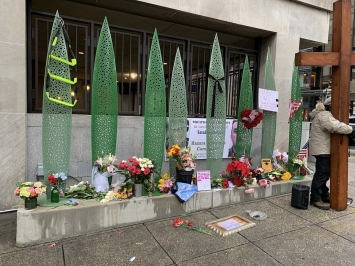 war in Afghanistan.
Image by Spirit of the Eagle cc by SA 4.0: Memorial to Washington D.C. shooting victims
“We reject and condemn anyone who uses, or seeks to use, violence, and we stand with every American who is horrified and saddened by this crime,” Shawn VanDiver, founder and president of AfghanEvac in San Diego, posted on X. He condemned the actions of the shooter, called for an investigation and accountability, but also urged that people not “demonize the Afghan community for the deranged choice this person made.”
VanDiver, a Navy veteran, noted that Afghan immigrants and wartime allies who resettle in the U.S. undergo some of the most rigorous security vetting of any population entering the country.
“We must work together—neighbors, faith groups, civic leaders, and all who believe in justice—to extinguish rhetoric that seeks to sow fear and hate,” he concluded. “Our organization stands ready to support healing, to speak truth, to demand justice for the victims, to ensure the promise the United States made to our Afghan allies are kept, and to continue to support the Afghans who love America and are part of the fabric of our nation.”
Tazheen Nizam, executive director of CAIR San Diego, a Muslim civil liberties organization, reports, “CAIR-SD has seen an increase in  calls from Afghan families whose loved ones are suddenly facing ICE contact, unscheduled check-ins, and new threats to their immigration status in recent days, adding to fear and uncertainty in a community already living with the trauma of war, displacement, and family separation.”
In a statement, Nizam said she accompanied an Afghan refugee to a supposedly routine check in where “despite full cooperation, he was detained immediately. We’re hearing the same fear from long-time green card holders, already-vetted refugees, and families who have waited years to reunite with loved ones now trapped in limbo.”
Photo: Afghan refugees boarded a U.S. military flight to evacuate Afghanistan amid the Taliban takeover. Many fear violence, restrictions on human rights, or death at the hands of the Taliban if deported back to their homeland.
Nizam says that legally, such “sweeping, nationality-based response to the alleged actions of one person arises serious due process and equal protection concerns,” adding that CAIR is “prepared to challenge any discriminatory enforcement targeted Afghan nationals or other communities of color.”
Specifically, she says, the visa and processing freeze, combined with increased ICE enforcement, means that:
- Families who have waited years to reunite with loved ones now have no timeline for when—or if—they will see them again.
- Green card holders who have lived in the United States legally for years fear sudden disruption to their status or increased scrutiny at ICE check-ins and ports of entry.
- Asylum seekers who fled Taliban persecution face indefinite limbo with no clear path forward.
- Afghans abroad who risked their lives supporting U.S. missions are left stranded, despite explicit promises of protection and resettlement.
- Community members fear harassment, surveillance, and detention based largely on nationality.
CAIR-SD is expanding outreach to the Afghan community, offering Know Your Rights training, consultations, and legal support to those impacted by these policies and enforcement actions and resources in Pushto and Dari.
Community members who experience immigration delays, detentions, harassment, or rights violations are encouraged to contact CAIR-SD for assistance.



Recent comments