
 Printer-friendly version

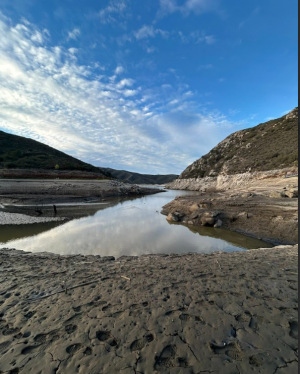 Loveland Reservoir showing what is left of the public fishing zone. Photo by Ostan Patton
By Karen Pearlman
Dec. 5, 2025 (Alpine) – It’s been three years since Loveland Reservoir was drained by Sweetwater Authority to “deadpool” level for the first time ever, leaving the area susceptible to environmental challenges, killing fish and increasing fire hazards.
Now another extreme draining is underway by Sweetwater Authority (SWA), the special district that oversees Loveland Reservoir and Sweetwater Reservoir as well as the Sweetwater Dam.
Locals are concerned again now, with the Alpine-housed reservoir dipping below 32 percent of capacity as of Thursday morning. The reservoir has been steadily dropping from its 63 percent capacity in mid-November, as water transfers continue with water flowing downstream to serve drinking water customers in Chula Vista, National City and Bonita.
At the SWA's Nov. 12 board meeting, SWA General Manager Carlos Quintero alerted the agency’s directors that an atmospheric river was approaching and the agency would coordinate a water transfer to secure supply for the coming year. The transfers began Nov. 18 with valves fully open.
The agency confirmed on Tuesday that the water will continue to be drained from Loveland for another week.
Angel Marquez, public affairs manager for Sweetwater Authority, said SWA anticipates continuing the transfers “to secure water supply for the next year and a half.” The agency has said that it plans to leave about 25 percent of the water in the reservoir – but that unlike in 2022, SWA does not intend to bring levels down to deadpool.
“We will transfer water until we reach our intended goal,” Marquez said, noting the amount was about 10,000 acre feet of water. One acre foot of water is equal to just under 326,000 gallons of water.
Deadpool is a term used for the critically low water level in a reservoir where the water can no longer flow downstream through its outlets, and happens when the water level drops below the lowest point of the intake pipes, trapping water at the bottom of the reservoir, where its release for power generation or supply to communities is thereby prevented.
SWA’s daily reservoir levels are posted on the agency’s website here.
A majority of the water delivered to Sweetwater Authority customers is obtained from the Sweetwater River.
Reservoirs and SWA
In a Dec. 2 statement shared with East County Magazine, SWA emphasized that the practice is essential for keeping water rates low and maintaining its position as one of the most affordable water agencies in San Diego County. The statement noted that recreational activities like fishing, which is a popular pastime at the reservoir, will be “subject to water availability.”
Sweetwater Authority owns and operates two local reservoirs: Loveland Reservoir and Sweetwater Reservoir.
Loveland Reservoir has a capacity of 25,400 acre feet. Its dam is 203 feet high and 765 feet wide, and was completed in 1945. Loveland Reservoir serves as a holding area for water which is released to Sweetwater Dam.
Sweetwater Dam was completed in 1888 and undergoes frequent safety inspections to ensure that it will continue providing safe water storage into the coming century. Its Robert A. Perdue Water Treatment Plant is located on the north side of the reservoir which treats water from Loveland and Sweetwater reservoirs.
To protect and preserve water quality and natural habitat, Sweetwater Authority and the U.S. Forest Service (USFS) established a partnership to provide public fishing access at Loveland Reservoir.
In exchange for a parcel of land near the reservoir previously owned by the U.S. government, SWA provided land near Descanso to the National Forest System. That exchange increases natural habitat and forest lands available to residents, visitors and local wildlife.
At the same time, Sweetwater Authority has improved public fishing access at Loveland Reservoir. Shoreline fishing is also available at Sweetwater Reservoir.
In 1996, Sweetwater Authority negotiated a land swap with the U.S. Forest Service. As a condition, the authority promised to provide the public with a recreation easement extending between 3½ and five miles of shoreline access from sunrise to sunset, 365 days a year.
Karen Wood, head of the nonprofit group Friends of Loveland Reservoir (FOLR), said that SWA traded 1,550 acres of land from the USFS in exchange for a fishing easement and the ability to have shoreline fishing. But due to the last full draining of the reservoir, Wood said Loveland’s fishing pier was decimated and much of the fish with it.
“You can’t have shoreline fishing if there's no shoreline or fish,” she said.
More on the trade
In an email to SWA, Wood said that members of the FOLR “understand that the water in Loveland is used by your customers in the South Bay and that you have an obligation to them to provide affordable water. However, the Authority was granted 1,550 acres of Forest Service land at Loveland in exchange for the Authority’s obligation to provide access to lake users for fishing, birdwatching and hiking. These two obligations are not mutually exclusive and both can be achieved through a balanced approach.”
Kim Hales, a biologist with the FOLR group who lives in Alpine, said that SWA has previously officially stated that its mission is “to provide drinking water storage and to protect the quality of water in the Reservoir.”
“The Board of Directors and Sweetwater staff are strongly committed to this mission, in addition to preserving and managing the watershed and natural biological resources through a balanced approach to human and environmental needs,” Hales quotes from an SWA statement. “The Loveland Reservoir Shoreline Fishing Program is one such example of this commitment. By abiding by the rules of the Fishing Program, we can accomplish protection of the Reservoir, watershed and biological resources."
Hales said that the water being drained from the valley leaves its open space exposed to invasive plants like mustard, horseweed and grasses, and not the native plants like cattails that support the native birds, mammals, reptiles and amphibians that live in the area.
Hales said that while she is not a fish experts, anglers in the region have told her that while they have enjoyed some fishing, the fish have not rebounded, likely due to the loss of feeder fish, such as shad.
“Without shad, the larger predatory fish have little to eat to grow and repopulate,” Hales said. “Well, with this latest drain, more pressure has been applied. SWA has shown no desire to restock the fish.”
Jamul resident Russell Walsh, said that Loveland capacity at 30 percent to 35 percent full would maintain the Forest Service easement-protected fishing program, and the fishing float can remain in place for public use. But the SWA’s 25 percent target will either eliminate it or nearly do so.
“Given losses in the middle basin and greater evaporation at Sweetwater Reservoir, this feels to powerless citizens like targeted destruction of East County recreation, yet it provides little benefit to Sweetwater customers,” Walsh wrote in an email. In a separate email to ECM’s editor, he indicated that this time, Sweetwater has moved its floating fishing dock to deeper water to protect it from destruction, but putting it out of reach for the public to utilize for fishing.
Leaving the reservoir at 25 percent “is very destructive to the fishing program and disgusting,” Walsh wrote. “By leaving 35 percent instead, the fishing program, which is owed from the Forest Service land swap, Sweetwater should give back the land and return the Forest Service Fishing Program to government (oversight) where it was before the land swap. A good portion of that 10 percent difference will be lost to absorption in the transfer and greater evaporation down at Sweetwater Reservoir.”
He added,“This is a disgusting way to kill the fishing program and doing a bait-and-switch on the acquisition of the 1,550 acres of Forest Service land. Give the old legal fishing program back and reverse the corruption on the land swap by taking the 1,550 acres back into federal ownership.”
County Supervisor Joel Anderson has not officially weighed in on the state of the reservoir’s water draining, but did send a letter to the SWA that promised to continue to support recreation access at Loveland.
“My constituents residing in the unincorporated communities surrounding Loveland Reservoir continue to reach out with their request to see access for fishing and recreation expanded,” Anderson wrote.
Rainy weather and the reservoir
Although San Diego County is reportedly out of official drought status according to the U.S. Drought Monitor, mostly due to recent storms that brought significant rainfall (about 1 inch in most of East County, 1.24 inches in Alpine in the mid-November “atmospheric river”), some areas are still considered "abnormally dry. The status improvement is part of a larger trend of drought relief across Southern California, which experienced its wettest start heading into fall in decades.
But this year will bring the La Niña, warns Hales, who is also a governing member of the Padre Dam Municipal Water Board District.
La Niña is a weather phenomenon characterized by cooler-than-average sea surface temperatures in the equatorial Pacific Ocean that impacts global weather patterns. This cooling leads to stronger trade winds and can cause a variety of effects, including wetter conditions in the Pacific Northwest and drier, warmer conditions in the southern U.S. during winter.
Meteorologists say that La Niña conditions are expected to be in place for the county during the winter of 2025-26, likely bringing a drier-than-normal season. Forecasters with the Climate Prediction Center anticipate La Niña will likely continue through at least the early part of the winter and could persist into the spring. The National Oceanic and Atmospheric Administration has forecast a higher probability of below-normal precipitation for Southern California, along with warmer-than-normal temperatures for the season.
The State Water Resources Control Board has heard from the community about the local watershed issues, led by Walsh’s consistent voice in championing the Loveland Reservoir. He has been to Sacramento to lobby and share concerns about the draining of Loveland and has been promised.
Walsh said that CSWRCB Chief Counsel Michael Alden Mahaney Lauffer emailed him in early November “saying we would have an Zoom meeting with the Region 9 Executive Director David Gibson in about a month from that date.”
Walsh said “that would put the meeting now or soon. Unfortunately I have not heard from them. And it also coincides if it were to happen with the end of the fishing program- destroying transfer, which is with days of being finished.”
Walsh said the only caveat would be if we get rain, then “the fishing program could be restored in good shape this year. But that's up to nature, not reasonable management by SWA.”
The state’s Water Resources Control Board weighs in
ECM reached out to the California State Water Resources Control Board, asking at what point can the state step in when there is imminent danger due to low water levels and what authority the CSWRCB might have to stop a transfer that is below a historic minimum pool from taking place?
Ailene Voisin, from the CSWRCB office of public affairs sent the following response from the group:
“The State Water Resources Control Board administers a water right permit and licensing system for post-1914 appropriations (diversion for beneficial use not authorized under riparian right) of water. The board also has authority over all diversion and use of water to apply the constitutional prohibition against waste and unreasonable use of water and the common law public trust doctrine.
“The Sweetwater Authority claims a pre-1914 appropriative right to the entire flow of the Sweetwater River. They also have a water right license (11734) that permits them to divert up to 14,600 acre-feet annually in Loveland Reservoir and limits the maximum withdrawal in any one year to 14,300 acre-feet. License 11734 lists the point of diversion as Lake Loveland Dam and the point of re-diversion as Sweetwater Main Dam. The license does not set any minimum reservoir levels that must be maintained.”
Voisin said that the water board staff does not know if water levels in Loveland Reservoir are at or below historic lows, “although with the relatively large amounts of rainfall in Southern California this fall, that seems unlikely.”
She said that reservoirs below historic levels would not necessarily be a water right violation.
“The issues concerning adequacy of the water rights relied upon are (1) whether they are diverting more water to storage than authorized under their water rights, or (2) are using more than they are authorized to use under their water rights,” Voisin wrote. “Diversions and use that is otherwise authorized under a party’s water rights may constitute a waste and unreasonable use, but staff is not aware of any case where otherwise authorized diversion and use of water for its intended beneficial use (e.g., a use such as domestic, municipal, or industrial use) has been determined to be unreasonable based on effects of a reservoir on a non-navigable stream for recreational use or for availability of a water source for firefighting.”
Firefighting concerns
Beyond recreation, local residents are also concerned about firefighting resources.
Wood said that the reservoir serves as a critical water source for helicopters (operated by SDG&E and the San Diego Sheriff's Department), which use dip tanks to fill their water buckets during wildfire response.
California Department of Forestry and Fire Protection trucks and other firefighting vehicles can also draw water directly through on-site hydrants. CalFire uses helicopters to fight wildfires by dipping buckets or using snorkel systems to fill internal tanks with water from reservoirs, lakes and other water sources.
Some specialized tanks called “heli-hydrants” can be located near communities, allowing helicopters to refill their 1,000-gallon tanks from a city water supply without landing, significantly speeding up response times.
Leaving Loveland Reservoir at low levels could deprive the region of this major firefighting resource during fire season, both Wood and Hales say.
CalFire has not yet responded to ECM’s request for comment on the matter.
The Trump administration’s dangerous cuts to the U.S. Forest Service earlier this year also threatens the safety of communities across the state.
In July, the U.S. Forest Service reported it had lost 10 percent of all positions and 25 percent of positions outside of direct wildfire response – both of which are likely to impact wildfire response this year.
CalFire’s history with helicopters in firefighting dates back to the 1960s, when the department first utilized choppers for reconnaissance and transport, their versatility and ability to operate in challenging terrain leading to their adoption for fire suppression and to support ground crews.
In the 1980s, CalFire began its helicopter fleet with the Bell Huey, and for more than four decades, the Huey has been the workhorse of the CalFire “Helitack” program.



Recent comments