
 Printer-friendly version

 By Miriam Raftery
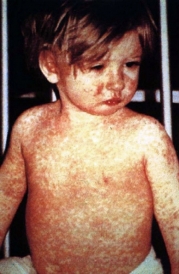
Photo: Child with measles, via CDC (public domain)
February 7, 2026 (San Diego) – Measles, declared eradicated in the U.S. in 2000, has made a comeback, with 2,267 cases last year—nearly all in unvaccinated people. So far this year, 588 cases are confirmed so far—including Los Angeles County. An international traveler with measles visited crowded venues including Disneyland Jan. 28 and Los Angeles International Airport Jan. 26-27, raising fears that Southern California including San Diego County could experience an outbreak of the highly contagious disease.
Measles is one of the most contagious infectious diseases, spreading through airborne droplets that can linger in the air for hours and survive on surfaces.
Before 1963, when vaccines became widespread, measles caused nearly 50,000 hospitalizations and 500 deaths annually, as well as over 1,000 cases of severe brain inflammation each year. It can also cause hearing loss, and wipe out immunity to other diseases. Among unvaccinated children, measles is fatal in 1 of every 1,000 cases.
Who needs a vaccine?
- Children: The Centers for Disease Control recommend two doses or the MMR vaccine for children, starting at 12 to 15 months with a second dose at age 4-6 before starting school. A first dose can be given as early as 6 months if an infant or child is traveling internationally or in an active measles outbreak area.
- Adults: Adults born before 1957 are presumed to have had measles and thus have natural immunity. Adults born between 1957 and 1967 may have received only dose of a vaccine or received an inactive version, PBS reports. Adults born between 1963 and 1967 may have received a killed measles vaccine, which is less effective than live vaccines. If you are in this age group (1957-1968) and don’t have proof that you received two doses of active vaccine for measles, you may wish to get a measles booster shot or have a blood titer test to check for measles immunity.
Who should not get a measles vaccine?
You should not get this vaccine if you are pregnant, if you’ve had a severe previously to the MMR vaccine or a vaccine component, or if have a known severe immunodeficiency such as from cancer, chemotherapy, HIV infection or congenital immunodeficiency.
Precaution is advised if you are ill, have a personal or family history of seizures, need a TB test, have a blood platelet deficiency or bleeding disorder, or have received an antibody-containing blood product in the last 11 months.
Symptoms of measles include a rash that starts at the head, fever, cough, and red watery eyes. If you develop symptoms, stay home and call your doctor to avoid exposing others in a healthcare clinic.
Anyone exposed to measles who has not yet been vaccinated should do so immediately before symptoms occur. If exposed within seven days, immune globulin may also be prescribed by a healthcare provider.



Recent comments