
 Printer-friendly version

By Karen Pearlman with additional reporting by Miriam Raftery
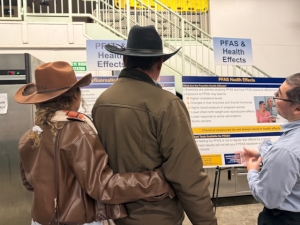
Jan. 14, 2026 (Warner Springs) -- Dozens of local residents and business owners visited the CAL Fire Station in Warner Springs on Jan. 12 to glean information from the United States Navy and several other federal groups as well as state and county water agencies about PFAS and their impact on the waterways in the region.
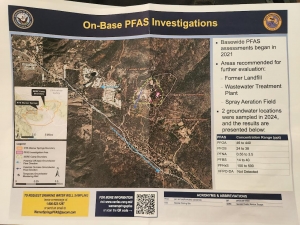
The U.S. Navy announced late last year that PFAS were detected in groundwater in Warner Springs, with contamination believed to be linked to a former landfill, wastewater treatment site and spray aeration field at the Navy’s Remote Training Site in Warner Springs,at 34567 State Route 79. The Navy most recently sampled the groundwater in 2024 and is now offering testing of wells for residents in approximately a one-mile radius near the site.
The site reportedly was used by the Navy as a Survival Invasion Resistance Escape School, using what they learned from Vietnam era prisoners of war. There, pilots are taught thow to survive if you crash or must eject, how to navigate, not be found, or if found how to resist interrogation.
PFAS, or per- and polyfluoroalkyl substances, are "forever chemicals" that have been found in water as far away as the Arctic Ocean and as near as the Sweetwater Reservoir locally, as well as in Warner Springs.
People on the ground and their groundwater
The Warner Springs region has a collection of farms and ranches, of which many rely on groundwater for livestock to drink and to irrigate crops. There are also a group of businesses in the area, including wineries, that rely on water for irrigation and wine production.
The Navy has started to conduct tests on well water on private properties nearby and held the meeting to share information and answer questions from the public as they launched testing this month.
PFAS are part of a family of chemicals used by many industries and in numerous products since the 1940s, and incapabale of breaking down in the environment. Scientific studies show that exposure to elevated levels of PFAS can cause serious harm to human health and the health of animals.
Some of the harms found include reproductive effects (decreased fertility, increased high blood pressure in pregnant women); developmental effects or delays in children (low birth weight, accelerated puberty, bone variations behavioral changes); increased risk of some cancers, including prostate, kidney and testicular cancers; reduced ability of the body’s immune system to fight infections, including reduced vaccine response; interference with the body’s natural hormones; and increased cholesterol levels and/or risk of obesity.
Joining the Navy at the CAL Fire station were representatives from the Regional Water Quality Control Board, the County of San Diego’s Public Health Services and the California Office of Environmental Health Hazard Assessments.
Locals spill out their concerns
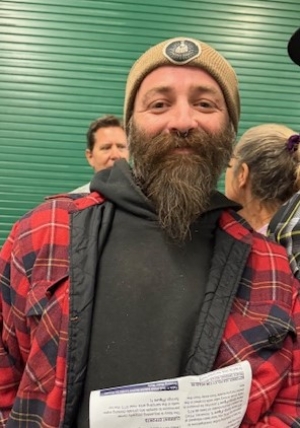
Phillip “Turtle” Shinkowski (photo, below right) said he is concerned about whether Navy tests will be accurate and plans to do his own testing; so is a neighbor of his. They plan to do a”full panel” of tests for a variety of potential contaminants.
“We’re all talking,” he said of his neighborhood.
Koby Loosen runs Sierra Roble Winery and Vineyard, at 34810 CA-79, about 1.3 miles away from the U.S.Navy Remote Training Site in Warner Springs. Since he took over the site in 2022, Loosen has had a commitment to organic farming and sustainable winemaking -- something of which he is now deeply concerned about considering the PFAS-in-the-water issue.
"I'm scared to death," Loosen said as he walked around a room at the CAL Fire station where large boards were placed, each sharing different pieces of information about PFAS, where they have been found to be in different concentrations at the Navy's site, the federal government's part in investigating the amount of chemicals in the water, the environmental cleanup process and more.
Different officials stood at the boards explaining what they could share about the various pieces of PFAS testing information.
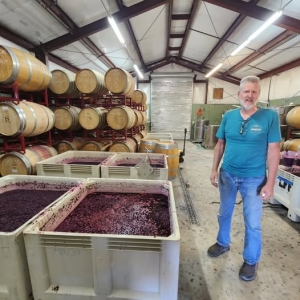 Loosen (photo, left, of Koby Loosen at his winery last October by Karen Pearlman) said his well water was going to be tested on Jan. 13, but that he wouldn't know the status of his water or get findings reported for at least 30 days. Loosen said that people who live in a residence across from the winery along Highway 79 had previously begun testing their well water.
Jose and Vanessa Rubalcaba say they live next door to the property being tested, and are concerned about the PFAS in the water not just for them, but for the animals who share space on their property, including chickens, horses and goats, who also drink the water.
The Navy has not yet indicated what testing or mitigation, if any, might be provided to local farmers, ranchers, wineries or other business owners, nor whether it would provide drinking water for pets in households where water is found to have concerning levels of PFAS contamination.
Scientific studies report that livestock exposed to high levels of PFAS have suffered cancers, birth defects and death. According to the National Wildlife Federation, many PFAS are persistent, bioaccumulative and toxic, linked to tumors in animals, lower reproductive success in birds, and liver, kidney and immunological effects in laboratory animals.

Vanessa Rubalcaba said her concerns also relate to drinking the milk of cows, who are drinking water on their premises.
"We're also worried because we're washing dishes with that water and showing with that water," Jose Rubalcaba said.
The Rubalcabas were also having their water supply tested this past week.
Because many PFAS get taken up in organisms and increase in concentrations up the food chain, the chemicals can have impacts on fish and game species, the NWF reports.
Next steps
Many Warner Springs ranches are on leased land from the Vista Irrigation District.
According to VID records on its website, the District owns about 43,000 acres of land adjacent to Warner Springs near the junction of Highways 79 and S-2 (San Felipe Road) in northeast San Diego County. The land was acquired by the District from the San Diego County Water Company in 1946, is largely undeveloped and consists primarily of open grasslands, with areas of chaparral, oak woodland and riparian corridors.
"These natural communities provide habitat for several rare and endangered species, including Stephens’ kangaroo rat, arroyo toad, southwest willow flycatcher, bald and golden eagles, and others," the District's website shares.
The Vista Irrigation District said on its website that in 2025 it tested Warner Springs' water supply for PFOA and PFOS as required by the United States Environmental Protection Agency and no PFAS were detected.
The EPA's shared guidance on use of water with PFAS contamination for bathing, showering, washing dishes is as follows, according to the federal website:
"The EPA guidance states that bathing, showering, and washing dishes with PFAS-contaminated water are not significant sources of exposure because PFAS are not easily absorbed through the skin; ingestion through drinking and food preparation is the primary concern."
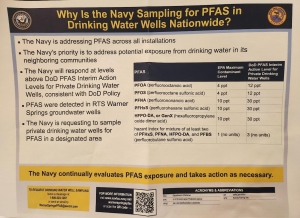
The Navy said if their results show PFAS levels at or above the Department of Defense’s PFAS interim action levels for private drinking wells, the Navy will work with property owners to implement a solution "as soon as possible," Navy officials told people at the CAL Fire station.
Those at the informal meeting told residents and business owners that plans for "enduring solutions" could include providing bottled water for those whose water wells have PFAS levels greater than 70 parts per trillion, connections to a public water supply or installation of a drinking water treatment system.
Those with PFAS levels that come back as being below the 70 ppt threshold, will be addressed by the Navy to Environmental Protection Agency standards in accordance with requirements of the Comprehensive Environmental Response, Compensation, and Liability Act.
For those concerned about PFAS in food, such as crops grown with the water, it’s possible to have labs test food products, but so far Navy hasn’t offered to do this.
Warner Springs resident Joe Mullen said he and his wife don’t drink their well water, but have done some farming.
"I’m glad to see the federal government involved," he said.
For more information on this, visit the Navy's PFAS site here.



Comments
PFA's are in the air we breathe as well...