
 Printer-friendly version

 Residents, gardeners should take precautions to protect against deadly disease transmitted by snails, slugs, and animals that ingest them
By Miriam Raftery
March 7, 2026 (San Diego’s East County) – Rat lungworm (Angiostrongylus cantonensis), a brain-eating parasite, has been found for the first time in San Diego County. It can be transmitted to humans, pets and wildlife with potentially deadly results. It was found in 10 opossums taken in by wildlife rescuers across the county that were euthanized after falling ill. The locations where the opossums were found include La Mesa, the College Area, Bonita, Peñasquitos, Cardiff by the Sea, Carlsbad, Point Loma, and San Diego. In addition, rat lungworm was also found in three rats and a wallaby at the San Diego Zoo.
The public is advised to thoroughly wash fruits and vegetables that may have been exposed to snail or slug slime. Don’t eat raw or undercooked snails, frogs, freshwater crabs, prawns, or slugs that can transmit the disease. Also avoid drinking from garden hoses into which slugs may have crawled. Take steps to eliminate snails, slugs, and rats near your home and garden (using traps, since poisons can harm birds of prey and pets that eat dead rodents). Use gloves to handle snails or slugs. Cover water tanks and other water source to keep slugs and snails out.
This is the first time that rat lungworm has been found west of Texas in the U.S. The testing was conducted by the San Diego Zoo Wildlife Alliance and its partners, including the
Humane Society’s Project Wildlife, Calif. Department Fish and Wildlife, the state’s Animal Health and Food Safety Laboratory, CEU Universities, and the University of California, Davis. The study results were published in the Center for Disease Control’s journal, Emerging Infectious Diseases.
The testing commenced after a wallaby born the Zoo developed neurological symptoms including paralysis of legs, blindness and head shaking. The wallaby was euthanized in December 2024 and found to have rat lungworm disease.
In early 2025, the carcasses of roof rats (killed by pest control or found dead on the zoo grounds) were tested and 3% tested positive, after which testing was done on opossums, which regularly eat snails and slugs, putting them at high risk in areas where rat lungworm disease is present.
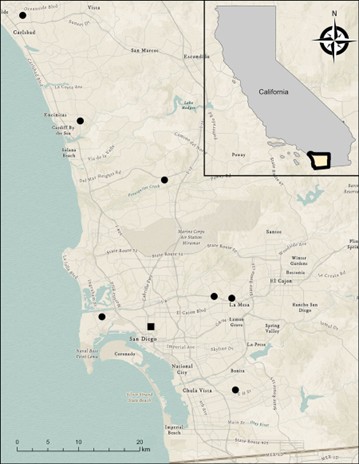 Map, right, shows locations where opossums were found that tested positive for rat lungworm disease. Source: Centers for Disease Control’s Emerging Infection
A spokesperson for the San Diego Zoo Wildlife Alliance told CBS 8 that it found the disease because the Alliance was “looking in places few others are looking.” The Alliance has shared its findings with the California Department of Public Health and suggested additional research is needed.
The study concluded that the cases found in wildlife in San Diego County “provides support that A. Cantonensis lungworm could now be considered endemic in this portion of southern California, with the potential to spread to other part of the western continental United States.
Oddly, neither the California Department of Public Health nor San Diego County Health and Human Services have yet issued any warnings or advisories for the public nor for physicians regarding rat lungworm. However CDPH spokesperson Elizabeth Manzo, in a statement to the Los Angeles Times, said, “Additional surveillance and testing will be necessary” adding that the department is not aware of rat lungworm elsewhere in California and has not seen any human cases.
The disease was first identified in China in 1935. The first cases in the U.S. occurred in the 1960s, starting on the East Coast, and are believed to have originated here from rats that came over aboard ships . It has since spread across the southeastern U.S., as well as to Texas and Hawaii.
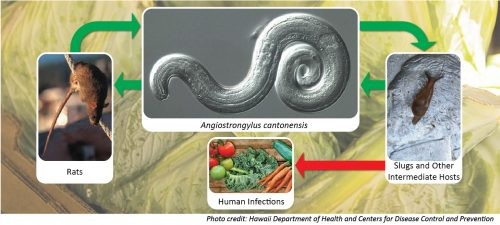
The worms most commonly are found in the lungs of rats, causing rats to cough and swallow worm-filled sputum. The worms’ larvae are later transmitted via rat poop consumed by snails, slugs or other animals. Any person or animal that eats an infected animal, or slime from an infected snail or slug, may contract rat lungworm disease. Though less common, other animals can also host rat lungworms, including opossums, freshwater crabs, frogs and more.
Hawaii’s Department of Public Health advises that the disease is now endemic in all of the Hawaiian islands, emphasizing that early diagnosis and treatment are important to reduce long-term consequences. The department has published a guide on what to know about rat lungworm disease, or neuroangiostrongyliasis including testing guidelines for clinicians.
Symptoms may occur days or up to six weeks after exposure. Symptoms range from mild headache, vomiting, fever, cough, rash and/or fatigue to muscle twitching, convulsions or seizures, severe neurological debilitation, coma, or death, though most cases are non-fatal.



Recent comments