
 Printer-friendly version

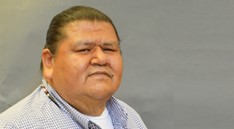
Photo via SDSU 2011 news release
January 6, 2026 (Campo) – Dr. Harry Paul Cuero Jr., former chair of the Campo Band of the Kumeyaay nation, spiritual leader and educator dedicated to preserving Kumeyaay sovereignty culture and leading efforts to share indigenous Bird Songs with future generations, died on December 6 at age 65.
Cuero, known as Junior, dedicated efforts to preserve and promote sacred Bird Songs that encapsulate the cyclical nature of life, death, and rebirth in Native American tradition. In his youth, he was profoundly influenced by the tribal history recounted through music, starting at a funeral he attended at age 8.
In 2011, San Diego State bestowed him with the honorary degree of Doctor of Humane Letters in recognition of Cuero as a cultural icon, mentor, leader, and oral historian. An SDSU news release at the time quotes Cuero discussing his mentorship of tribal young people.
“I try to give them pride in who they are, in their belief system and culture,” he stated. “If you really understand who you are, you can fit in anywhere,” he said. “We bridge the gap between cultures by getting educated and then filtering what we learn through our own cultural lens.”
He served as treasurer, cultural chair and in 2004, became chair of his tribe, as well as an advocate for indigenous sovereignty and indigenous cultural preservation at the national level.
He played a crucial role in drafting, analyzing and refining the California Native American Graves Protection and Repatriation Act (NAGPRA), the Kumeyaay-Diegueno Land Conservancy (KDLC), and the Indian Child Welfare Act (ICWA),. But Cuero’s interpretation of the Bird Songs is one of his greatest legacies to the Kumeyaay Nation, inspiring many Kumeyaay young people to embrace their heritage through singing, dancing, and a strong connection to tribal traditions.
He was known for mastering the takut, a cycle of 300 Bird Songs. He performed at the White House and at the opening of the Smithsonian National Museum of the American Indian, as well as leading a group of Kumeyaay youth in a performance with the San Diego Symphony exploring links between traditional indigenous and contemporary American cultures.
Though widely respected, his leadership at times generated controversy, notably over the leasing of portions of the Campo reservation for wind energy development which provided clean energy for the tribe, but also drew opposition from some tribal members and neighbors concerned about noise and other impacts.
According to his obituary on Dignity.com, Dr. Cuero’s contributions extended beyond his tribe, as he championed causes such as the Kumeyaay Cultural Repatriation Committee (KCRC), the California Native American Graves Protection and Repatriation Act (NAGPRA), the Kumeyaay-Diegueno Land Conservancy (KDLC), the Indian Child Welfare Act (ICWA), and stood as an advocate for Indigenous rights.
He is survived by his wife, Jodene Cuero; their children, Janelle and William; and their grandchildren, Mathayus, Troy, and Logan.
His obituary concludes, “Junior now traverses the cosmos, guided by the same stars he once taught us to admire. Though his physical presence is no longer felt, his spirit continues to permeate our lives through our songs, ceremonies, courage, and love for one another. His voice resonates, his teachings inspire, and his legacy forever resides within the hearts of his people.”
In Cuero’s own words, “The song begins, the sun goes down, darkness comes, a constellation appears and moves across the night sky and then the sun rises. All the little stories in between the sun setting and the sun rising are the stories of life, and no one goes through life alone," Cuero said. "That is the lesson of the Bird Songs.”



Recent comments