
 Printer-friendly version

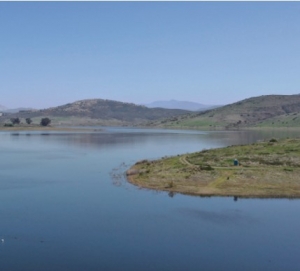 Photo: PFAS have been detected in Sweetwater Reservoir, via Sweetwater Water Authority
By Karen Pearlman
Jan. 8, 2025 (San Diego County) -- “Water, water everywhere, nor any drop to drink” goes the line from Samuel Taylor Coleridge’s 1798 poem, The Rime of the Ancient Mariner, describing sailors surrounded by undrinkable ocean water.
That old phrase also fits today.
Obtaining clean, fresh water is not only a challenge but also part of a global crisis where much of the water is either saline, contaminated, or polluted — or a combination of all three.
Sweetwater Water Authority (SWA), the special district providing water to 200,000 customers in the South Bay area of San Diego County, has been at the forefront of the battle to fight “forever chemicals” that refuse to break down: Per- and Polyfluoroalkyl Substances (PFAS).
The source of our drinking water, whether it flows from a tap or is sold in a bottle, relies on a vast, interconnected network: rivers, lakes, streams, ponds, reservoirs, springs and wells. As water travels over the surface of land or through the ground to reach these sources, it dissolves naturally occurring minerals and radioactive material.
But as it moves, it also acts as a vacuum, picking up substances left by the presence of animals or from human activity.
While drinking water may reasonably be expected to contain at least small amounts of some contaminants — though their presence does not always indicate a health risk — increasingly, the substances picked up along the way include a variety of man-made chemicals that the natural world simply cannot process.
Beyond the taps, PFAS are pervasive — found in soil, air, food, personal care products and even household dust. However, the contamination of drinking water systems has become an urgent priority due to the tendency of PFAS to accumulate in groundwater, turning an invisible presence into a public health emergency.
There appears to be significant hope on the horizon.
On Dec. 25, researchers at Rice University announced a landmark breakthrough: a new layered double hydroxide (LDH) material that can trap and destroy PFAS significantly faster than current carbon filters. Developed by researchers Keon-Ham Kim and Youngkun Chung under Professor Michael S. Wong, the “super-material” LDH is reported to remove PFAS 100 times faster than commercial filters and can be regenerated for reuse through thermal decomposition.
But while the lab results are revolutionary, Southern California’s water managers must still contend with the infrastructure of today.
Local impacts and challenges
Sweetwater Water Authority in late 2024, found PFAS in the Sweetwater Reservoir. Early samples were below immediate action levels, but subsequent tests in early 2025 showed levels that exceed state notification thresholds and required public alerts. SWA since then launched a public education campaign and held workshops.
SWA has acknowledged the high levels and does not have permanent treatment in place for reservoir water, though it has done studies and is working toward getting funds. The district has been actively managing the detection of PFAS since they were first identified in the system late last year. In 2024, Perfluorohexane Sulfonic Acid (PFHxS) and Perfluorooctanoic Acid (PFOA) were detected in the Sweetwater Reservoir at levels exceeding the state's public notification thresholds.
SWA General Manager Carlos Quintero has blunt words for the situation, calling the chemicals “one of the sins of civilization” and acknowledging that PFAS are now “just everywhere.” And he isn’t wrong.
The district’s cheapest available short-term fix has been to drain down Loveland Reservoir in Alpine, a body of water that feeds into SWA’s Sweetwater Reservoir, in order to dilute the chemicals.
SWA’s main challenge is geographic: the contamination is located directly in the Sweetwater Reservoir. While the upstream Loveland Reservoir remains relatively clean, the contamination appears to enter from the watershed between the two, or directly drains into the Sweetwater Reservoir itself.
To maintain safe supply, SWA currently "blends" reservoir water with cleaner water from uncontaminated upstream sources or imported water.
While SWA leadership has identified probable sources of the PFAS contamination, the exact entry point remains a mystery. However, the geographic suspects are well-known: the watershed feeding the Sweetwater River includes areas upstream from two decommissioned landfills, which are known to leach contaminants, including PFAS, into the groundwater and runoff that eventually reaches the reservoir.
But that draining has drawn vocal objections from recreational users at Loveland due to negative impacts on wildlife in the area, and in particular the ability to fish from the reservoir.
Permanent feature
PFAS have transcended their industrial origins to become a permanent feature of the Earth’s natural systems.
Researchers report that PFAS are now found in the blood of 97% of all Americans and in nearly every person on the planet.
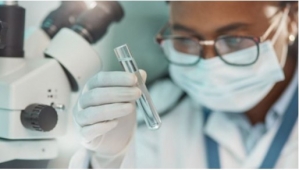 Photo via U.S. Environmental Protection Agency
In 2022, a major study found that levels of PFAS in rainwater — even in the most remote areas of Antarctica and the Tibetan Plateau — often exceed the EPA’s lifetime drinking water health advisories, leaving scientists to believe that there isn’t a place on Earth where “pure” rainwater that meets modern safety standards can be obtained.
Additionally, PFAS have been detected in more than 600 animal species, and because the chemicals biomagnify, they get more concentrated as they move up the food chain —from plankton to fish to humans.
PFAS are also in the products that create the runoff – in the non-stick coating of a frying pan, the waterproof lining of raincoats, the stain-resistant treatment on sofas, and even in dental floss and mascara.
Helix Water District General Manager Brian Olney has a degree in water science technology and joined HWD in 2000 as a water treatment plant operator.
Olney said that his own personal feeling about PFAS “is the same as it is for all other possible risks in water and for that matter all things we do in life, including taking medications, eating processed food, using certain hygiene products and wearing certain clothing.
“All these actions have risk associated with them and PFAS is not different. If PFAS is identified at levels in water, then you enable infrastructure to manage it the same way you would with any other risk. One difference with PFAS is that the infrastructure to remove or reduce it is very expensive and this will have an impact on communities.”
Olney concludes, “As PFAS and other contaminants of emerging concern become regulated, the price of water will become the primary cost of living in a community.”
The road to remediation: contracts and timelines
Despite the complexity, SWA has treated the issue as a top-tier priority. According to spokesperson Liana Letsos, SWA leadership launched a comprehensive outreach campaign to keep its Board of Directors and the public informed on monitoring progress.
SWA has now completed one full year of required PFAS testing and established a PFAS Mitigation Fund using settlement dollars, Letsos said.
In May 2025, SWA received an initial net payment of approximately $957,000 from a settlement with 3M. By June, the fund was formalized to ensure every cent goes toward cleanup. As of late 2025, the total reserve has grown to over $3.7 million.
“As we continue moving forward, our next steps include pursuing additional funding, developing preliminary designs for a long-term treatment solution, and completing final design by June 2028,” Letsos said.
The strategy focuses on the Robert A. Perdue Water Treatment Plant.
In June 2025, SWA hired engineering consultant Tetra Tech to serve as the owner’s representative. More recently, on Dec. 5, 2025, SWA’s Engineering and Operations Committee recommended awarding a $1.5 million contract to Carollo Engineers, Inc. to develop the PFAS Preliminary Design Report.
This contract is a major milestone. Carollo, selected for their “unmatched PFAS expertise” and more than 70 similar projects, will conduct a pilot program to test Granular Activated Carbon (GAC) and Ion Exchange (IX) technologies. The goal is a final facility design by June 2028, following a preliminary report due in August 2026.
A global and biological crisis
The history of PFAS is a cautionary tale of industrial convenience. Used since the 1940s in products from Teflon to Aqueous Film-Forming Foam (AFFF), these compounds were prized for their ability to repel heat, oil, and water. That same durability makes them a biological nightmare; they accumulate in the human body and have been linked to cancer, liver damage, and immune system harm.
The impact is not limited to humans. PFAS have been detected in more than 600 animal species globally. From polar bears to dolphins, scientists have documented severe impacts on reproductive systems. In Europe, particularly in France and the United Kingdom, these findings have sparked a level of public anxiety that is now mirrored in the U.S.
In America, “hotspots” are often found near industrial sites and military bases like MCAS Miramar and Camp Pendleton. The military faces a unique challenge: replacing AFFF without compromising firefighting safety for jet fuel fires.
The Department of Defense recently obtained its second and final waiver, extending the deadline to stop using PFAS-containing foam until Oct. 1, 2026, to allow for a safe transition of 1,000 facilities and 6,000 mobile assets.
Navigating a shifting regulatory landscape
Water districts are currently navigating a “moving target” in Washington, D.C.
In May 2025, the EPA under the current administration revised its 2024 standards. While they kept the strict 4 parts per trillion (ppt) limit for PFOA and PFOS, they rescinded national limits for four other types (GenX, PFHxS, PFNA, and PFBS) and extended the compliance deadline from 2029 to 2031.
California, however, maintains its own trajectory.
“The state regulation will likely be prior to 2031 or in alignment with the original 2029 deadline,” Olney explained. “It will be regulated by California rather than the EPA, and California will be the primacy agency.”
Olney notes that San Diego is in a unique position. Because most agencies in the county rely heavily on imported water from the Colorado River and the State Water Project — which currently show no PFAS issues — few have local supplies that are directly impacted. Those that do, like Sweetwater, face a steeper, more expensive climb.
Helix has complied with all EPA and state monitoring requirements to date and has not had any PFAS detections in the treated drinking water it distributes to customers, Olney said.
“We do have concerns with the extremely low monitoring levels specified in regulations, measured in the parts-per-trillion range,” he said. “We understand that there are real issues with PFAS in several areas of the country and with specific water sources, but it is certainly not widespread at every water agency in the country.”
A look at Padre Dam’s purified water
Santee-based Padre Dam Municipal Water District has been the agency looking ahead of the curve for decades, with its East County Advanced Water Purification Program (see photo, below right, courtesy Padre Dam Municipal Water District). The project began construction in 2022, with the aim to start producing and delivering purified water to East County residents by late 2026.

The ECAWP will use microfiltration, reverse osmosis and ultraviolet light with advanced oxidation to turn recycled water into drinking water and comply with all regulations for indirect potable reuse. Although its treatment technologies were specifically designed to comply with indirect potable reuse regulations, and not based on PFAS regulations or compliance, reverse osmosis is also the best available technology to remove PFAS.
Melissa McChesney, spokesperson for Padre Dam, wrote in an email that as a new water supply project, the East County AWP will have current state-of-the-art treatment technologies when it goes online and begins producing water and that its advanced technology creates extremely clean and safe drinking water.
“The purification process removes viruses, bacteria, salt, chemicals, pharmaceuticals, PFAS and more,” she wrote. “The water is so pure that minerals are added back into the water at the end of the process. As with all of our water supplies, the East County AWP will make any modifications or updates necessary to ensure the water produced at future facilities continues to meet future water quality standards.”
The Yorba Linda "gold standard"
For a vision of success, San Diego County can look north.
Faced with contamination from the Santa Ana River, the Yorba Linda Water District (YLWD) took what its General Manager Mark Toy called “bold action.”
YLWD constructed the $28 million J. Wayne Miller, Ph.D. Water Treatment Plant, the nation's largest Ion Exchange system. Completed in 2021, the facility uses 22 massive tanks filled with positively charged polymer beads that act as magnets, pulling negatively charged PFAS out of the water.
The plant treats 25 million gallons per day, allowing the city to avoid the high cost of imported water.
“Our drinking water doesn’t just meet standards — it exceeds every state and federal regulation,” Toy said.
“The precision is staggering: they can detect contaminants down to a single part per trillion — roughly equivalent to finding one drop of water in 20 Olympic-sized swimming pools,” Toy said.
Toy’s advice for districts like SWA is to plan for long-lead times on equipment and to integrate with utility providers early to avoid delays in building the massive treatment magnets.
Broader San Diego context and what’s next
PFAS contamination is not confined to the Sweetwater Reservoir. Historical testing has shown PFAS in other parts of the county, including a well in the city of San Diego near El Cajon (since taken offline and blended).
At the end of last year, the United States Navy announced that PFAS were detected in groundwater in Warner Springs. The contamination is believed to be linked to a former landfill, wastewater treatment site and spray aeration field at the Navy’s Remote Training Site in Warner Springs. (The Navy is offering to test well water on private properties nearby and will hold a public meeting from 5 to 7 p.m. Jan. 12 from 5 to 7 p.m. at the Cal Fire Station, 31049 State Route 79 in Warner Springs.)
The Navy has offered to test wells within a designated area and if high levels are found, to provide bottled water for residents for drinking and cooking until a long-term remediation plan is developed.
The Vista Water District has confirmed that PFAS were not found in recent testing of the Lake Hodges Reservoir in the Warner Springs area.
There are also reported significantly elevated levels of PFAS at a well in the southern portion of Camp Pendleton, the U.S. military base where firefighting Aqueous Film-Forming Foam is a known source of PFAS.
According to government reports, the military faces challenges in fully replacing it quickly without compromising safety, leading to extended use for critical situations, but training now uses alternatives.
Camp Pendleton, like other Department of Defense bases, has been transitioning away from traditional AFFF due to PFAS contamination, using it for emergency responses, under strict controls and with waivers extending use past the initial deadlines. (The DoD obtained waivers to continue some AFFF use until October 2026 to manage the transition safely.) Military installations are actively switching to PFAS-free alternatives for training and testing.
Water providers across the county are now under pressure to comply with the EPA’s new stricter standards by the 2031 deadline. For any water system, the necessary solution is expensive, involving either activated carbon filtration or the ion exchange resin technology pioneered by Yorba Linda.
The challenge for Sweetwater Authority and other San Diego water providers is now to swiftly implement the expensive, large-scale treatment solutions that have successfully restored water quality in northern Orange County, while simultaneously addressing public concern and tracing the local sources of contamination.
The road ahead
As we move into early 2026, the pressure is on county providers to implement the large-scale solutions pioneered in Orange County.
While researchers at Rice University work to bring their LDH technology to scale, the immediate future of San Diego’s water depends on the civil engineering projects currently being designed by firms like Carollo and Tetra Tech.
In May 2022, the city of San Diego filed a lawsuit against more than 20 PFAS manufacturers as part of a larger legal effort to hold manufacturers like 3M and DuPont accountable for contaminating water with PFAS from firefighting foams. Through the litigation, the city has been seeking to recover cleanup costs and proving manufacturer deception, in hopes of securing funds for water remediation.
Also in November 2022, the state filed a similar lawsuit against the PFAS-making companies, seeking statewide treatment and funds for health/environmental impacts.
With more than 15,000 active lawsuits against manufacturers of the forever chemicals, the battle for funding is as intense as the battle for filtration.
The goal remains clear: to ensure that the “Ancient Mariner’s” nightmare stays in the history books, and that every drop in the county – and around the globe – is safe to drink.



Recent comments