
 Printer-friendly version

 By Alexander J. Schorr
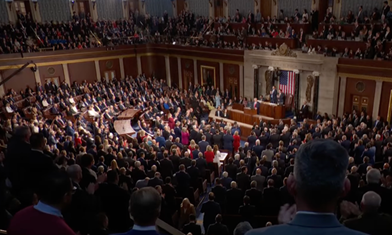
Screenshot: President Donald Trump addresses a joint session of Congress at the Capitol during his State of the Union Speech
“It is indeed a turnround for the ages,” President Donald Trump, 2026
February 27, 2026 (Washington, D.C.) — President Donald Trump gave his 2026 State of the Union address on Wednesday, touting the first year of his second term as “a turnaround for the ages.” However, his nearly two-hour speech contained many false and exaggerated depictions, including misleading claims of an economy that has many Americans struggling amid an affordability crisis, a soaring deficit, and tariffs that have sent costs of many goods skyrocketing. The speech also omitted mention of many key issues and glossed over a dubious record on some others.
The speech came on the heels of plummeting ratings, with just 36% approving of the President’s job performance and 68% of those polled by CNN saying Trump hasn’t paid enough attention to the nation’s most serious problems, such as affordability. The shadow of Epstein’s legacy also loomed large over the chamber, as well as a possible war with Iran.
Trump claimed the economy is “roaring,” slammed Supreme Court justices for finding some tariffs to be illegal, and hammered on immigration, among other key points. It’s important to fact check any president’s statements, particularly Trump’s, given his track record.
Trump’s State of the Union address is likely a test run of the message the Republican party will give to voters ahead of the midterms, with control of the House and Senate at stake. The President and his party appear vulnerable, with recent polling showing Republicans and the Trump administration losing ground on key issues including immigration and affordability.
How do Trump’s promises match his record?
President Trump came into office again making big promises to cut government spending. But he’s done the opposite, raising the national debt to an all-time high of $38.8 trillion, Fortune reports. Meanwhile he’s slashed government services to the American people while enriching himself, boosting his personal net worth by more than $3 billion. Yet he failed to mention these facts in his speech.
Controversial actions
Among other controversial actions that he did not discuss or glossed over, Trump:
- Pulled the US out of the World Health Organization.
- Attacked the US Federal Reserve.
- Abandoned vaccine science— allowing a greater spread of diseases and illness like measles, polio, and leprosy.
- Reversed key climate change findings that protected Americans from air pollution, prompting a lawsuit
One key victory touted by Trump is helping negotiate release of Israeli hostages held by success, a bright spot for his administration.
But other actions have made things less safe for people in American cities and in some cases, around the world as the Trump administration has:
- Put armed soldiers into the cities of America to garner violence that can be exploited political— at the cost of lives including Renee Good, Alex Pretti, and Keith Porter due to a trigger-happy ICE and Border Patrol.
- Eliminated U.S.AID, which Harvard University estimates has resulted in hundreds of thousands of deaths around the world in 2025.
- Invaded Venezuela and arrested its president.
- Threatened to bomb Iran.
- Threatened to Invade Greenland.
- Alienated allies including Canada
In 2025, Donald Trump had a 50% approval rating on immigration— which has been his perhaps his biggest issue. He did in fact shut down the border and it was effective, because when the country is hostile and accused of human rights violations, it becomes less appealing to visit. But at what cost?
When you look at deportation, former President Joe Biden sent away more people in 2024 than Trump did in 2025— and critically, the people that Biden sent were significantly more likely to have a criminal conviction unrelated to immigration. Trump deported fewer people than Biden and subsequently fewer violent criminals, all while permitting racial profiling, trafficking, torturing, abusing, and killing American citizens in the process. This may explain why his approval on this issue dropped from 50% to 38% this year.
Scamming Americans with DOGE
Trump touted putting Elon Musk in charge of a Department of Government Efficiency (DOGE) to slash staffing and programs at federal agencies.
DOGE said that it would cut $2 trillion, and then revised that goal to just $150 billion. A year later, a number of analyses show that DOGE did not find significant waste, fraud, and abuse, but did take the personal data of Americans off of government servers and send it to third parties..
In addition to putting at risk the personal information of Americans at risk due to DOGE (The Department of Government of Efficiency) by illegally claiming Social Security records, Trump, with the help of Elon Musk, has made government not only more difficult to use for good, but act as a deterrent for personal security and independence throughout the country.
For weeks, people waited for Trump and Musk’s promised “DOGE checks,” and then later “tax refunds” as a promise for rewarding the people with money that was supposedly liberated from waste, fraud, and abuse. Trump said that he would cut regulations and deliver working class economic relief— but those DOGE checks are not coming, and no one got relief.
The Partnership for Public Service, a non-profit that focuses on the federal workforce, estimates that paid leave, mistaken firings, multiple lawsuits, and lost productivity from DOGE’s activities mean it is also cost taxpayers $135 billion, putting the DOGE dividend at about $35 billion in net savings, or about $89 per household.
This is a measly “savings” for less efficient federal agencies, lost government data, shutting down local libraries, neglected national parks, deteriorated veterans care, less research on Alzheimer’s disease and cancer, more Third World children born with HIV, worse weather forecasts, and even worse disaster relief— just to name a few effects of the DOGE cuts
The Affordability Pitch
Donald Trump has been claiming that he “won” on affordability because prices are still rising, yet they are rising slightly slower than when he took office. Inflation has risen 2.4% overall in the past year, somewhat less than during the COVID pandemic, but continue to rise. However, prices in some sectors have skyrocketed much higher due to tariffs that Trump imposed on goods such as imported foods as well as imported lumber (including a 45% increase on lumber from Canada), foreign-made cabinets and other building supplies, making the housing affordability crisis even worse. The auto industry has also been hard-hit by tariffs on important steel, to name just a few of the industries hard-hit by tariffs that have hit consumers squarely in their wallets.
In his speech, Trump falsely claimed the price of eggs and beef have dropped since he took office for his second term. However, prices for chicken and beef have increased since Trump took office in January 2025.
Ground beef cost $6.75 per pound, on average, in January — the highest level on record, according to data from the U.S. Bureau of Labor Statistics. Prices have increased 22% over the past year, from $5.55 per pound in January 2025, when Trump started his second term.
Back in about 2006, key items in around three bags of groceries would have cost $30. In 2016, there was a 33% increase, making them about $40. Now on average in 2026, the price of groceries will increase by 87% to $56, which is almost double what they cost only 20 years ago.
The cost of goods is only half of the issue when it comes to affordability, with the other half being income. In 2006, the minimum wage was only $5.15 an hour, which is about equal to $8 an hour today. In 2016, the minimum wage had risen to $7.25 an hour, which at the time, would be equivalent to $9.50 today. But today, it is still $7.25 an hour.
Even if you set aside the issue of inflation or the cost of living, the minimum wage rose only based on worker productivity. It would be only $48,000 a year today— that is $24 per hour, about three and a half times what it is today. Workers know this, and they know that they are getting more predictive and smarter than ever, but they are not feeling a bit of the rewards because 100% of those gains are going to billionaires and their shareholders.
This is happening at the exact same time that people are holding onto their money more than ever because of Donald Trump’s tax cuts, all while job growth flatlined in 2025, and tariffs raised the prices on almost everything an American purchases. Trump is also now the first President since the Great Recession to lose jobs four months out of the year, all while gutting healthcare subsidies in order to contribute to his tax cuts for the very rich.
More unfortunate yet, in the alleged service of reducing the amount of goods we import every year, making it more shocking that we imported more goods in 2025 than the US ever imported under Joe Biden:
- 2024 (Biden): ~$3.36 trillion
- 2025-early 2026 (Trump): ~$4.33 trillion
Imports under Trump’s current term based on the latest complete year are higher than in Biden’s final year, though part of that increase is due to economic growth and inflation and not just policy changes.
Between 2020 and 2024, inflation increased about 40%. Between 2020 and 2026, inflation increased about 55— 60%, with grocery inflation having peaked around 2022— 2023 and remains elevated under the Trump administration.
Health and prescription Drugs
Based on CPI drug inflation and price increase, there was roughly a 5–10% increase between 2024 and 2026, with overall drug spending going up from 15–20% which was driven by usage and newer drugs. In the scenario for insurance, prices rose from $65–$170 per month. In 2026, it rose from $70–$185 per month.
A typical insured American patient is paying roughly $10–$20 more per month in 2026 than in 2024, though of course individual experiences vary. For a realistic chronic-disease prescription mix, the increase between 2024 to 2026 is noticeable, with a “typical increase” being about $120–$240 per year
In addition to more price hikes, an August 2025 Congressional Budget Office Analysis showed that 2.4 million Americans who are projected to lose their benefits following the passage of Trump’s One Big Beautiful Bill Act— and not necessarily people who were able to afford to be off them, would also lose access to the Supplemental Nutrition Assistance Program (SNAP) after the law expanded work requirements.
SNAP has required certain able-bodied adults to work to receive benefits for longer than three months, but the law expanded work requirements, mandating that parents of dependent children ages 14 and older, volunteer, or participate in job training at least 80 hours a month. The law also requires adults ages 55 to 64 veterans, people experiencing homelessness and those who were formerly in foster care to meet new requirements, and exempts Native Americans.
About 42 million low-income people receive benefits through SNAP, receiving an average monthly benefit of about $190, or $356 per household. Recipients can use the benefits to buy food, as the majority of SNAP households live in poverty.
And speaking at a “counterprograming” rally before Trump’s address, senator Chris Murphy (D-Conn.) said that “Millions of Americans are losing their healthcare because the president has chosen corruption to pad the pockets of his billionaire friends instead of helping average Americans.
On January 1, enhanced tax credits that helped reduce health care costs for most people purchasing insurance through the Affordable Care Act (ACA, or Obama Care) expired. The healthcare research nonprofit KFF estimated that the premium costs would more than double in 2026 for enrollees of the ACA. There have been anecdotal examples of how people have dropped their insurance.
Additionally, health analysts and the nonpartisan Congressional Budget Office reported that the subsidies' expiration date would trigger rising costs, and force Americans to forgo health insurance coverage. Also, Early Centers for Medicare & Medicaid Services data showed that about 1.5 million people may have already dropped their insurance in 2026.
The Economy and job losses
The deficit last year was $1.8 trillion, and this year the congressional budget office projects that the deficit will be $1.9 trillion. Trump increased the military budget by another $500 billion. As a result, Trump’s approval rate on running the government went from 49% last year to 35% this year.
Trump is also now the first President since the Great Recession to lose jobs four months out of the year, all while gutting healthcare subsidies in order to contribute to his tax cuts for the very rich.
It is a remarkable feat to find a way to make products and necessities more expensive while creating fewer jobs while people get paid less. This may contribute to the fact that his approval of the economy, which was 50% last year, is now only 33% this year.
President Trump has been trying to persuade the public that the state of the economy is fine, even after prices rose 3% in the 12 months ending in September, alongside consumers spending less on larger value items on the holidays.
Even though prices on some items like gasoline have fallen, the overall cost of living has continued to climb, with grocery cost being up at 2.7% and electricity jumping more than 5%, according to the Bureau of Labor Statistics.
Please never forget that in a wide ranging speech to supporters, Trump defended his track record on the economy, telling his crowd in Mount Pocono, Pennsylvania, that he believed that the term “affordability” was a “hoax” created by Democrats, and dismissed rising inflation through assertions not backed by official government economic data.
Trump and his administration have argued that tariffs are necessary to correct past global trade policies that have been “unfair” to the US and to bring back domestic manufacturing. Even though tariffs have been raising $30 billion per month in revenue for US coffers, the import taxes that he levied have increased prices on items ranging from food to clothing and furniture.
Americans are having to take out loans on their groceries: nearly 1 in 4 (25%) of Americans now use “buy now, pay later” loans to pay for groceries, which is a 14% increase from the previous year. Driven by high inflation and financial strain, consumers are using services like PayPal, Klarna, and Affirm to break up payments, with some resorting to “loan-stacking.”
Also, there are numerous reports that depict a growing number of Americans are even selling their blood plasma to make money and cover essential expenses like rent, groceries, and medical bills; though it is illegal to sell whole blood in the US, it is legal to be compensated for plasma domination. An estimated 200,000 people visit more than 1,200 plasma centers across the country every day to donate for compensation. The US accounts for roughly 70% of the world’s plasma supply, mainly because paid donations are permitted here but are restricted in most other countries. This practice has become too common an economic coping mechanism, particularly for low-to-middle-income individuals.
It is a remarkable feat to make products and necessities more expensive while creating fewer jobs, keeping wages low, slashing services that Americans have long relied upon, and spiraling the nation’s deficit.
This may contribute to the fact that his approval of the economy, which was 50% last year, is now only 33% this year.



Comments
great article