
 Printer-friendly version

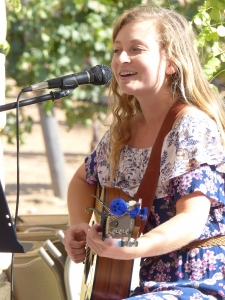 Photo by Miriam Raftery
By Karen Pearlman
Feb. 4, 2026 (San Diego County) – For the winemakers of East County, the sound of progress has long been a quiet one.
Under current San Diego County laws, the region’s smallest “boutique” wineries -- the family-run operations that make up an important part of the local agriculture scene -- have been silenced when it comes to amplified music.
That silence may soon be broken.
Next week, the San Diego County Board of Supervisors is set to vote on a pivotal amendment to the county’s wine ordinance.
If passed after discussion at the Feb. 11 Board of Supervisors meeting, the ordinance will allow boutique wineries to host amplified live and mechanical music.
The change is a move that supporters say is less about turning vineyards into concert venues and more about survival in a modern economy.
Sue Robinson is president of the Ramona Valley Vineyard Association and with her husband, Doug, owns Correcaminos winery.
Sue Robinson said that the change would bring a long-overdue leveling of the wine-growing business playing field.
While larger “small wineries” as well as those considered “large wineries” have enjoyed more flexibility, boutiques have been restricted by-right.
The San Diego County Vintners Association and recent County Economic Impact reports say that as of early 2026, San Diego County has about 115 to 125 total active wineries. Of those active sites, the majority -- roughly 90 to 100 -- are reported to fall into the "boutique" category, including about 30 in what is known as the Ramona American Viticultural Area.
“Allowing background music adds to the ambiance of our tasting rooms and patios,” Robinson says. “It gives guests another reason to linger and visit, without turning us into event venues. Music becomes an enhancement to the wine experience -- not a replacement for it.”
A closer look and background
The draft ordinance is specific: music must be “accessory” to the wine tasting. Wineries cannot charge a separate ticket fee for the music, and anything that remotely resembles a "concert" remains prohibited.
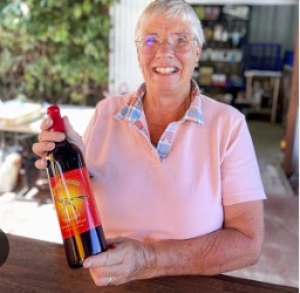
Robinson (photo, right) said that wineries understand that caveat. And at least at Correcaminos, “music is truly in the background,” she said.
"Guests come to enjoy wine and conversation -- they don’t want to shout over a rock band,” Robinson said. “When music supports conversation rather than competes with it, you know you’re still within the spirit of a tasting experience.”
The road to the coming vote hasn't been paved with easy meetings. The movement for music at boutique wineries gained momentum following a 2024 noise complaint against a local winery, an event Robinson calls a “painful necessity.”
Robinson said that the noise complaints “forced us to organize, engage the community and work directly with the County."
In February 2024, following a series of noise complaints against several Ramona boutique wineries that were considered to be operating in a “gray area” regarding music, Supervisors officially directed staff to explore changing the ordinance.
In 2024 and early 2025, consultants visited wineries to conduct noise measurements during live music performances to see what the real-world impact was, something of which Robinson remains skeptical of.
“The sound study methodology is flawed," she notes. "Measurements were taken in all directions, even though speakers are directional, and on hard surfaces like concrete... without accounting for soft landscaping that absorbs sound.”
But finally, last December, the County’s Planning Commission agreed unanimously that changes could be made to the original ordinance regarding wineries and music, which passed in 2010.
“The 'by-right' ordinance passed in 2010 was a good start, but most of us now recognize that this is a business -- and businesses evolve,” Robinson said. “Two years of meetings isn’t easy for volunteers, but sometimes it takes a kick in the pants to get meaningful progress moving.”
The 2010 ordinance -- championed by then-Supervisor Dianne Jacob -- created the "Boutique Winery" tier that allowed wineries to open tasting rooms “by-right” (ministerially), that included not needing a Major Use Permit, capping production at 12,000 gallons of wine and mandating that at least 25 percent of the grapes used in the wines be grown on-site -- protecting the agricultural nature of the business.
However, to get the “by-right” tasting rooms approved, the County included very strict “good neighbor” rules to appease locals who worried about increases in noise and traffic.
One of those original peacekeeping rules was a total ban on amplified music.
As Robinson said, the 2010 ordinance “uncorked” the industry, and grew Ramona from one tasting room to 30, but it also didn’t allow for music.
Sound limits are real
While the ordinance opens the door to music, there are protections within it. Among them, to ensure rural quiet time, the County is proposing a strict 50-decibel limit at the property line, and music allowed only during the daytime.
In order to meet the County’s rules without expensive permits, the updated ordinance says that speakers at any boutique winemaking venue must be set back at least 200 feet from property lines for, say, a singer/guitarist or more for larger groups such as a band.
For wineries with smaller or odd-shaped parcels, that distance may be tough to abide by. But the alternative is a Zoning Verification Permit, which at a cost of $1,655, plus an additional cost for a required professional sound study, may be out of wineries’ financial reach.
Despite the financial hurdles, Robinson emphasizes that boutique owners are committed to their neighbors. Unlike bars, these wineries that can open at 10 a.m. daily must cut the music at sunset, or 6 p.m. in the winter months.
“We are not open until midnight like a bar in town,” she said. “We all live here. Being good neighbors isn’t optional -- it’s essential.”
The proposed ordinance also has caveats that there can be no ticketed music events and no “spectator sports.”
It also explicitly forbids karaoke -- so while you might be sipping a glass of the good stuff, don’t expect to be singing “Red Red Wine.” You’ll have to leave the UB40 covers to the professionals, which is exactly the point of the new proposal.
The economy and agriculture
The proposed ordinance changes aren't just about selling more Syrah or meting out more Merlot, they’re also about the local ecosystem. By allowing live music, wineries can hire local musicians, creating a low-key and community-oriented economic boost.
Robinson said she is frequently asked if Correcaminos has music.
“Sadly, I have to answer no,” she said. “Am I losing customers to venues with music? Probably.”
She said she envisions “relaxed Sunday afternoons with a single musician playing on the patio” as the new standard for her winery.
As the Board of Supervisors prepares for the final vote, Robinson said that RVVA wants to ensure the distinction between a “party spot and a “working vineyard” remains clear.
“Most boutique wineries are owner-operated,” she said. “I know every vine on my property because I planted and tend them personally. We’re not large corporations with unlimited resources. This is agriculture first -- not nightlife.”
The timing of the Feb. 11 vote is critical.
If approved, the new rules would take effect just as the busy season of Spring and Summer begins.
“The timing couldn’t be better,” Robinson said. “Getting these changes approved before the spring and summer season allows us to move forward thoughtfully and responsibly. I’m genuinely excited about the positive impact this will have -- for wineries, musicians and the Ramona community as a whole.”
For more information on the subject, visit this website: https://engage.sandiegocounty.gov/winery-music








Comments
Respect...