 Printer-friendly version

 Bucking bronco horse at Calgary Stampede; Creative Commons image by SA 3.0 via Wikipedia
By Karen Pearlman
Feb. 11, 2026 (San Diego) — In a decision that could eventually bring change in the professional rodeo circuit, a judge with the the San Diego Superior Court at the end of January issued a landmark ruling against the San Diego Padres and the C5 Rodeo Company, the producer of the San Diego Rodeo event.
Following a week-long trial held just before the 2026 San Diego Rodeo, Judge Joel R. Wohlfeil determined in a 21-page ruling that specific practices during the 2024 and 2025 San Diego Rodeos constituted “needless suffering” and “unnecessary cruelty,” and determined that the San Diego Rodeo was to have proper medical technology on site and that pregnant mares were not allowed to be part of competition.
The San Diego Rodeo is an independent event not sanctioned by the Professional Rodeo Cowboys Association. Produced by C5 Rodeo Co. in partnership with the Padres, the rodeo just concluded its third annual run at Petco Park from Jan. 16 to Jan. 18, once again drawing sold-out crowds.
Specifically, Wohlfeil wrote that veterinary care at the San Diego Rodeo needs to include “on-site, comprehensive medical equipment, including, but not limited to, radiograph equipment, to adequately x-ray, scan, diagnose and treat the livestock – no matter the ‘size of the animal.’”
Wohlfeil also noted that “evolving rodeo practices” have led to changes in the sport, but that “more can and should be done to minimize the risk of ‘needless suffering’... while, at the same time, preserving the sanctity of the rodeo.”
Local animal welfare advocates say that the trial proved that in the high-stakes world of modern rodeo -- an industry with 43 million fans and which reportedly provides millions of dollars in charitable impact -- the “standard of care” has not kept pace with the risks, and that Wohlfeil’s decision moves toward a permanent injunction that should alter how rodeo events are managed.
Pearl Necklace and Waco Kid
At the heart of the case were two animal cruelty incidents at San Diego Rodeos in 2024 and 2025 that the court found were not simply tragic accidents, but also foreseeable consequences of systemic negligence. The trial brought to light the harrowing final moments in January 2025 of Pearl Necklace, a 17-year-old mare.
Despite being 10 to 11 months pregnant (a state of pregnancy that Wohlfeil declared was obvious even to an untrained eye) the horse was forced to compete in a saddle bronc bucking event. Pearl Necklace died shortly after from what veterinarians reported was a ruptured uterine artery.
The court’s scrutiny also extended to the 2024 injury of a 6-year-old thoroughbred named Waco Kid. Following a collision, the Padres and C5 Rodeo issued a press release claiming the horse showed no “obvious signs of fracture.” The court, however, found this statement to be “false and intended to mislead the public,” as the event lacked the specialized diagnostic equipment required to make such a determination.
Addressing this gap, Jace Huggins, Vice President and Chief of Humane Law Enforcement for the San Diego Humane Society, clarified that diagnostic tools and public statements are outside his team’s direct control.
“SDHS officers on site are responsible for monitoring animal welfare conditions and responding to observable violations of law, not for directing medical decision-making or managing event communications,” Huggins said.
Below right, a photo of a downed calf from the San Diego Rodeo. Photo provided by Brian Pease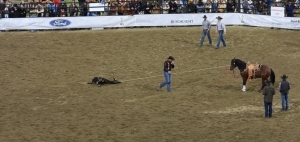
The legal victory was bolstered by the expert declaration of Dr. Peggy Larson, a veterinarian and attorney with a unique background as a former bareback “bronc” rider.
Dr. Larson in the court case provided a clinical breakdown of the trauma inflicted on the animals, specifically addressing the use of pregnant mares.
She detailed the physiological stress of bucking, and how it, combined with the use of flank straps, creates a catastrophic risk for horses in late-term pregnancy.
She argued that subjecting a mare in such a delicate state to the violence of a rodeo is a fundamental violation of veterinary ethics and criticized the absence of on-site X-ray technology as a “grossly negligent” oversight.
Reshaping the industry?
Local lawyer Bryan Pease, a pro bono attorney for animal welfare advocates the Animal Protection and Rescue League, said the verdict is a long-overdue correction. He suggested that local rodeos in Lakeside (set for April 23-26) and Poway (scheduled for Sept. 25-26) are now on notice.
“The needless suffering and unnecessary cruelty caused by using pregnant horses in bucking events can and should be similarly eliminated in the County of San Diego and City of Poway,” Pease said.
However, Huggins noted that the court’s order is currently limited in scope.
“The Statement of Decision does not impose any new duties, mandates, or enforcement requirements on SDHS... and it does not apply to other rodeos, producers, or events elsewhere in San Diego County,” Huggins stated, adding that any decision to impose countywide requirements rests with “legislative or regulatory bodies.”
SDHS initially cleared the Padres and C5 Rodeo of criminal wrongdoing following the death of Pearl Necklace, labeling it “accidental and unforeseen.”
Judge Wohlfeil responded by saying the SDHS’s testimony lacked credibility. Huggins explained that this discrepancy stems from the "distinct legal lenses" applied by his office versus the court.
“Our Humane Officers and veterinarians must determine whether conduct meets the high legal threshold required for criminal prosecution, including evidence of criminal negligence, intent, or recklessness,” Huggins said.
By contrast, the court’s ruling arose under the Unfair Competition Law, a civil statute with a “substantially lower burden of proof.” Huggins emphasized that civil findings of “unnecessary cruelty” do not equate to a determination that criminal laws were violated, and SDHS stands by its conclusion that evidence available at the time did not support criminal charges.
A look from the other side
Despite legal challenges, rodeo's popularity remains high. Officials from the PRCA argue that injuries are statistical anomalies and cite a 99.9% safety rating. The Padres maintain they were merely a venue operator with no “custody or control” of the animals.
Proponents argue the sport is a vital piece of cultural heritage and fundraisers for youth and community programs.
The largest rodeo in California and one of the top 15 professional rodeos in the U.S., the not-for-profit California Rodeo Salinas, has been around for more than 100 years. Set for July 16-19 this year, the California Rodeo Salinas reportedly distributed more than $770,000 to local nonprofits in 2025.
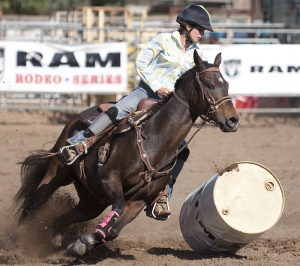 At left, barrel racing at a San Diego County rodeo. File photo by Ron Logan
The Poway Rodeo website notes that it supports Poway Onstage, the Poway Community Foundation, Poway Onstage, the Poway Community Foundation, Poway High Football, Poway Kiwanis, Rady Children’s Hospital of San Diego, Sam’s Posse, Southern California Youth Bull Riders, the Warrior Bonfire Program, Scouting America and the Golden Circle of Champions. The Poway rodeo is managed by the nonprofit Pro Rodeo Productions of Poway, Inc.
The Lakeside Rodeo is run under an umbrella organization, nonprofit El Capitan Stadium Association, and its website says that “annual donations to the Youth of Lakeside exceed $100,000 annually.”
Trauma and severe injuries
Advocates like Dr. Larson and Pease say the “low percentage” of injuries hides the severity of the trauma. The court found that the industry’s lack of transparency was a deciding factor.
While the legal battle continues, the SDHS maintains its long-standing moral opposition to the sport.
“While the court’s ruling does not alter San Diego Humane Society’s enforcement authority or responsibilities, it contributes to an evolving public conversation about animal welfare standards at large-scale livestock events, one that we welcome,” Huggins said.
“Entertainment should never compromise animal welfare. San Diego Humane Society remains firmly opposed to rodeos due to the inherent risks they pose and the fear, anxiety and stress they cause to animals. The organization’s stance has not changed since the first rodeo in the City of San Diego in 2023 when we lodged our initial opposition to the event.”
A final hearing is scheduled for 3 p.m., Friday, March 6 in Department 73 of the San Diego Superior Court to formalize the exact wording of the injunction.
Pease urged concerned citizens to write to each member of the San Diego County Board of Supervisors to demand the San Diego Rodeo restrictions be applied county-wide.



Recent comments