
 Printer-friendly version

 By Paul Levikow
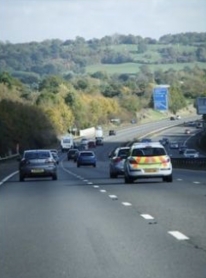
This Photo by Unknown Author is licensed under CC BY-SA
February 13, 2026 (Sacramento) – A tax aimed at charging motorists per miles driven may be coming to California. Or not. The State Assembly last month voted to approve a bill and send it to the State Senate that calls for the continuation of a study on the feasibility of a so-called mileage tax that could charge drivers anywhere from 6 to 9 cents per mile.
District 75 Republican Assemblymember Carl Demaio, who represents the East County, is vehemently opposed to such a tax. He called it a “sucker punch to working class Californians who are already suffering with a high cost of living” in remarks to his colleagues on the Assembly floor.
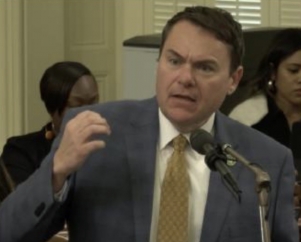 Photo, right: Carl DeMaio, screenshot from Assembly video during discussion on mileage tax
Existing law requires the chair of the California Transportation Commission to create a Road Usage Charge Technical Advisory Committee in consultation with the Secretary of Transportation to guide the development and evaluation of a pilot program assessing the potential for mileage-based revenue collection as an alternative to the gas tax. The law additionally requires the Transportation Agency, in consultation with the commission, to implement the pilot program by Jan 1, 2027.
‘Working class Californians have to drive longer, so it’s a more expensive proposition,” Demaio said. “When you add up the car (registration) tax, the gas tax, and this new mileage tax, for a family with two cars, a working family with two parents driving, they would have to pay $4,200 a year to the State of California just for the privilege of driving on crappy roads.”
AB 1421 was brought forth by Assembly Transportation Committee Chair Lori Wilson, a Democrat from Northern California, who says the bill responds to a reality that the state’s drivers can no longer ignore.
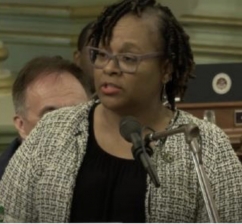 Photo, left: Lori Wilson, screenshot from Assembly video during AB 1421 discussion
“California’s transportation funding system is becoming less stable, less equitable, and less sustainable as more drivers switch to fuel efficient and zero emission vehicles,” Wilson said.“Despite what my colleague (Demaio) said…this bill creates a transparent, research-driven process to evaluate the advantages, disadvantages and inevitable trade-off a road user charge or mileage-based funding system so that the legislature in the future can make informed decisions.”
Demaio disagreed.
“What are we thinking here? I think we need to make a clear statement that this body will stand up for working families, that we don’t want a mileage tax snuck in at the local level or the state level, that it’s the wrong policy,” he said.
The bill passed the Assembly 43-18 and now awaits action by the State Senate.
“Today, drivers using the same roads often pay very different amounts for that use. Low income and rural commuters who must drive farther and less efficient vehicles can pay more, while others contribute less despite roadway impact,” Wilson said. “It’s a basic fairness question. How do we ensure all motorists pay their fair share, no more, and no less, while protecting affordability and privacy?”
Demaio’s Reform California website posted a statement.
“California’s greedy politicians have already imposed the highest GAS TAX and CAR TAX in the nation on drivers, and now they want to impose a new MILEAGE TAX to charge us PER MILE we drive to get more of our money!” the statement reads.
“The California Mileage Tax proposal would require tracking every driver’s mileage and charging them six to nine cents per mile they drive! That is the equivalent of a spike in the gas tax of between 87 cents and 1.15 per gallon of gas!”
“The typical California driver with an average drive of 15,000 miles a year will be forced to pay $900 to $1200 a year in higher taxes just to drive on poorly maintained freeways they already paid for with the original gas and sales taxes!” the statement continues.
“When you add the new MILEAGE TAX to the existing GAS TAX and CAR TAX, the typical two-car family will end up paying more than $4,200 in taxes a year for just the privilege of driving in California – not including the cost of the car itself!”
Demaio said the mileage tax is also an invasion of privacy – as it would include a tracking requirement that is still being determined by government bureaucrats. Proposed tracking methods include using transponders installed on every car to use of tracking apps to be installed on cell phones of every driver to simply requiring individuals get their odometer readings inspected annually.
Wilson says the Assembly Transportation Committee will hold a transportation funding town hall meeting in San Diego County and a statewide virtual town hall this year to get feedback from motorists who will be affected by any changes. It will be designed to hear from commuters, workers, businesses, community groups and local governments before any policy decisions are made.
“Let me be very clear. AB 1421 does not impose a new tax or fee. The research required under this bill will examine how to ensure motorists are not charged twice for the same road usage and that any future approach is both transparent and accountable, Wilson said. “It’s about getting the facts right, engaging Californians and ensuring our transportation funding system is equitable, fair and enduring for all motorists.”
This is not the first time San Diego County residents are faced with a mileage tax. The San Diego Association of Governments board voted to implement one for the County several years ago, but it was rescinded after public outcry.
Whether or not the California gas tax revenue is keeping up with demands to keep the state’s roads upkeep on track, depends on who you ask. Demaio says revenue is going up, while Democrats say it is going down. One thing that does not seem to be in dispute, is the amount of taxes Californian’s pay on each gallon of gasoline.
Meantime, East County residents who commute to the urban areas of San Diego, travel more miles daily than commuters who live near the city. How a mileage tax plays out has yet to be determined. In the event that a mileage tax is implemented, motorists can calculate what that would mean to their individual situation. But that won’t come this year. The current proposed law is only for studying options. A mileage tax would have to be taken up by a future state legislature.



Comments
Carl Demaio
Fantastic idea!